Canada’s Fighter Jet Choice Is No Longer Just About Jets

Wide documentary-style photograph of Canadian aerospace and defence infrastructure at dawn, showing hangars, runways, and industrial buildings under an overcast sky, representing the systems and decisions behind Canada’s fighter jet debate.

This is a long, deliberately paced essay. It does not argue for a single fighter jet, and it does not assume a quick answer. It examines the real options behind Canada’s fighter jet decision, the systems those choices lock in, and what each path would mean for Canada’s defence posture, industrial capacity, and alliance relationships over decades—not election cycles.

An Already International World Beneath Modern Borders

Polar projection map of the Arctic showing circumpolar coastlines and northern communities encircling the Arctic Ocean, with national borders intentionally absent.

Long before borders reached the top of the map — and before Greenland began making headlines — the Arctic was already an international world, shaped by Indigenous peoples, movement, and shared responsibility.

The Arctic Is Being Bracketed

A clear, high-resolution map of the Canadian Arctic Archipelago, showing the Queen Elizabeth Islands and surrounding island groups in detail. Clean academic style, light neutral colours, readable labels. Emphasis on the dense island geography and multiple Northwest Passage routes. Subtle markers for Alaska to the west and Greenland to the east.

Canada’s Arctic is no longer a distant frontier or a future concern. As global powers reinforce their positions at the Arctic’s edges — from Alaska to Greenland — geography, infrastructure, and capacity are quietly reshaping who sets the rules in the North. This essay explores why the Northwest Passage is not a single route but a complex system, how “bracketing” works in practice, and why Canada’s Arctic readiness can no longer remain abstract.

1

When the Anchor Drifts

Map of North America showing Canada and the United States in muted colours, emphasizing their shared landmass and long border without highlighting political leaders or events.

Canada has spent decades building its economy and security around American predictability. That assumption is now under strain. This essay explores what it means to live next door to a politically unsettled United States — in a world with no reliable referee — and the risks Canadians should be watching as 2026 unfolds.

1
What Happens When Democracy Loses Its Instructions?

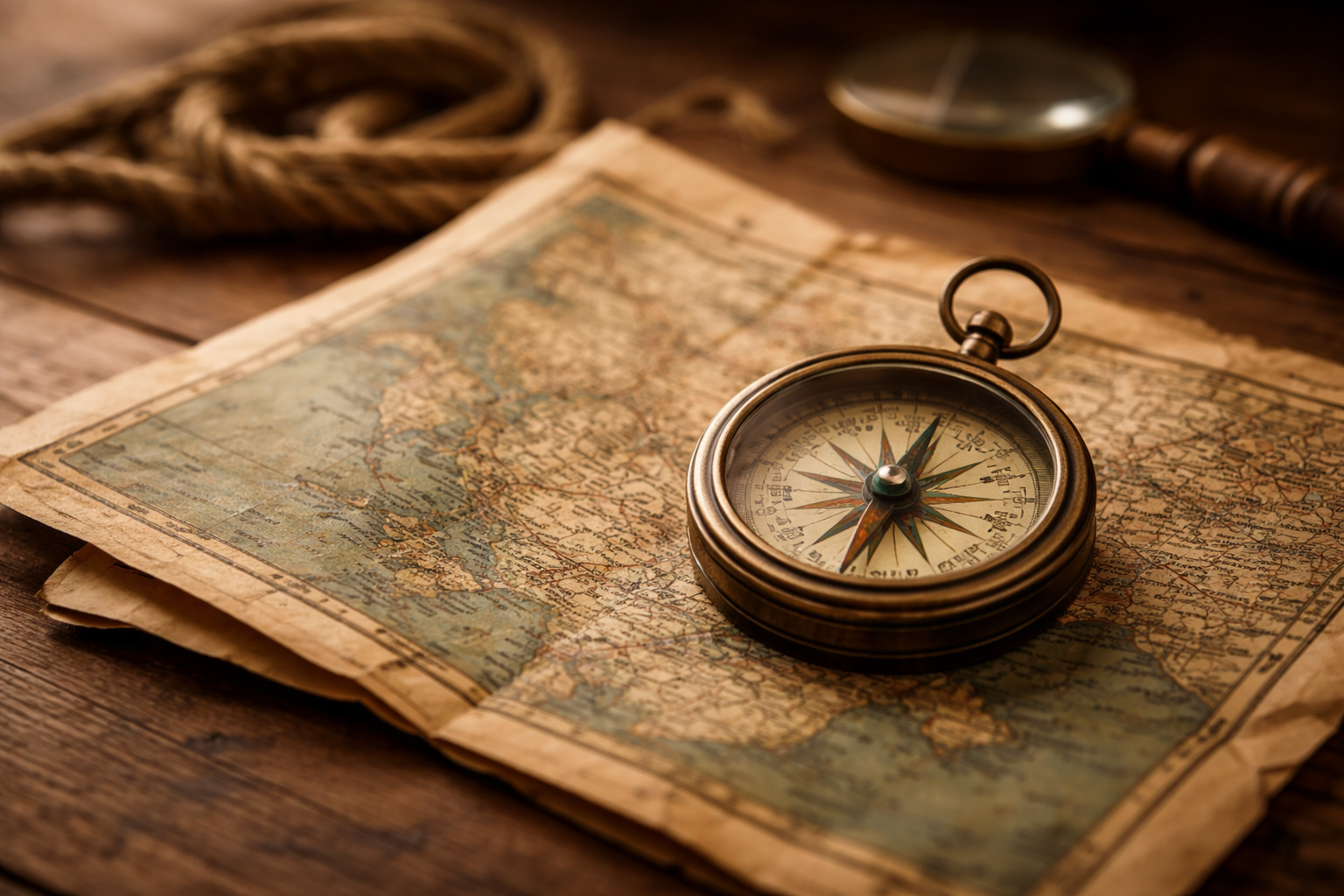
A brass compass resting on an old map, symbolizing navigation, orientation, and geopolitical decision-making in uncertain times.

Democracy doesn’t fail all at once. It erodes quietly when people inherit its responsibilities without the civic literacy needed to navigate it.

As education, media, and time have shifted, many Canadians have become politically saturated but civically disoriented — deeply engaged, yet unsure where power actually sits or how to act effectively within it. This Sunday reflection explores what we lost when the “user manual” disappeared, and why orientation now matters more than ever.

Interlude & Conclusion — Drift Is Not Destiny

An older woman stands at the end of a wooden dock, looking out over a calm Canadian lake at dusk. A Canadian flag flies beside her, with mountains and a soft evening sky in the distance.

A final reflection in A Quiet Reckoning. This interlude and conclusion step back from policy to trace how decades of quiet decisions are lived across generations — and what it will take to choose building over drift in the years ahead.