

Why Greenland, the Northwest Passage, and Canada’s Northern Readiness Are No Longer Abstract Questions
By Leni Spooner, creator of Between the Lines.
Power Shows Up on the Map
We tend to think of the world as a patchwork of countries — lines on a map, flags planted, borders defended. From that vantage point, the Arctic can look like a place that has only recently entered history: a remote expanse now “opening up,” newly relevant because ships can pass, minerals can be reached, and rival powers are paying attention.
That view only works if you start the story in the wrong place.
Power rarely announces itself through speeches alone. It shows up in geography — in infrastructure, in who controls access, sets standards, and decides what counts as “normal” movement through a place.
Seen that way, renewed American interest in Greenland looks less like an isolated fixation and more like part of a larger pattern. Alaska already anchors the western edge of the Arctic. Greenland sits at the eastern gate. Control at both ends would not require conquest to matter. It would quietly shape access, rules, and leverage across the Arctic system as a whole.
And that leaves one country in the middle.
Canada does not sit beside the Arctic as it changes. We sit inside it — embedded in a geography others are beginning to treat as strategic infrastructure. The question is no longer whether the Arctic is changing, but whether Canada understands the position it already occupies, and what kind of Arctic actor it intends to be.
The Arctic Was Never Empty
Long before modern borders reached the top of the map, the circumpolar Arctic was already an international world — just not in the way we usually mean that word.
Inuit communities travelled and traded across what are now multiple countries, linked by kinship, seasonal routes, and shared knowledge of ice and sea. Sámi herders moved with reindeer across northern lands later divided by states. Aleut and Unangan peoples lived along island chains connecting continents. Inland, Gwich’in and other northern peoples organized their lives around animals that paid no attention to future borders.
This was not isolation. It was connection.
Sea ice functioned as infrastructure — a working surface for travel, hunting, and visiting. The ocean was not an edge but a commons. Rivers were corridors. What mattered was not jurisdiction, but whether the ice would hold and whether knowledge passed down still matched how the land and sea actually behaved.
That world did not disappear when borders arrived. Borders were layered over it.
Modern states drew lines across the Arctic, asserting sovereignty from distant capitals. Those borders became real in law and enforcement — but they never replaced the older geography of Indigenous nations whose homelands, economies, and relationships continued to operate across them.
That layered reality still shapes the Arctic today.
Why This Matters Now
Climate change has not made the Arctic safe or stable — but it has made it usable in ways it was not before. Sea ice is thinning. Navigable seasons are lengthening. Technologies that once made Arctic travel exceptional are becoming routine enough to plan around.
This has drawn renewed global attention. Shipping routes are being discussed. Infrastructure is being proposed. Military presence is expanding. Strategic language is creeping northward, bringing with it assumptions about ownership, speed, and control.
What often gets missed is that none of this is happening in empty space.
The Arctic is not a blank frontier entering history for the first time. It is a lived homeland with long-standing systems of movement, governance, and stewardship. To understand what is unfolding now — from Greenland to the Northwest Passage — we have to start there.
The Arctic Corridor — and Why Bracketing Matters
When people hear “Arctic shipping route,” they often imagine a single line across the top of the world — a shortcut that either exists or doesn’t.
That isn’t how Arctic shipping works.
The Arctic functions as a system: a web of routes, seasonal openings, chokepoints, services, risks, and rules. Together, these determine who can move, when they can move, and under what conditions.
At the centre of that system sits the Northwest Passage.
What the Northwest Passage Really Is
The Northwest Passage is not one channel but a collection of routes winding through Canada’s Arctic Archipelago, linking the Atlantic and Pacific Oceans. For centuries, it existed more as an idea than a working trade route. Ice made it unreliable. Even when ships got through, doing so often required rescue.
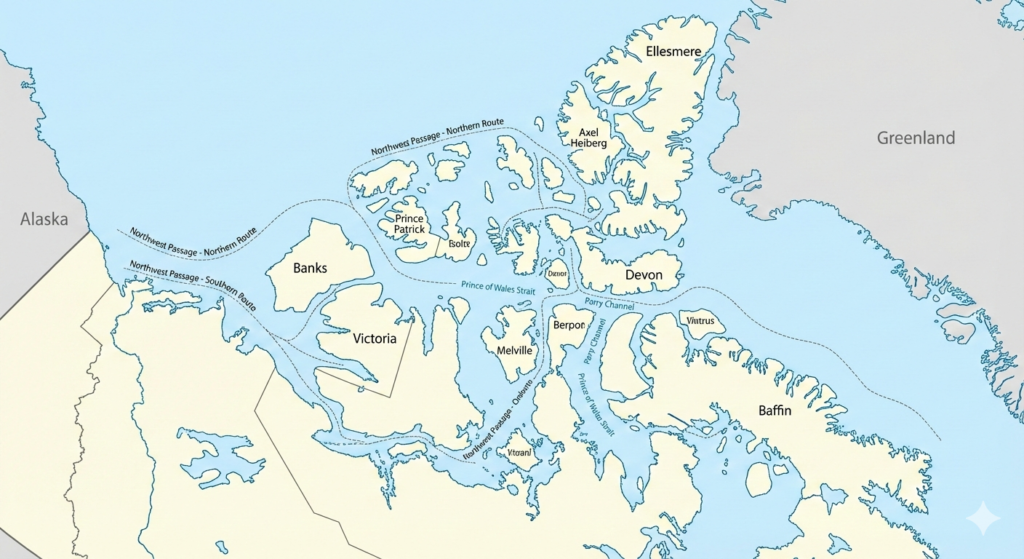
The dense island geography of Canada’s High Arctic creates multiple Northwest Passage routes, narrow choke points, and overlapping corridors that complicate infrastructure, monitoring, and governance.
In practical terms, the Passage was not usable enough to matter.
That has changed.
Climate change has thinned ice and lengthened navigable seasons. Better forecasting, satellite navigation, and reinforced hulls have reduced uncertainty. What was once exceptional is now predictable enough to plan around.
This does not mean the Northwest Passage is suddenly a global superhighway. Traffic remains limited. But systems begin to matter long before volumes explode.
Corridors Are About Rules, Not Traffic
Shipping corridors don’t become strategic because of how busy they are. They become strategic because of how decisions organize around them.
A corridor determines:
- which safety standards apply,
- who provides navigation and ice data,
- who coordinates emergencies,
- whose environmental rules are enforced,
- and which insurers decide a route is acceptable.
In other words, corridors are governed spaces.
The Northwest Passage runs through Canadian Arctic waters, and Canada asserts sovereignty over it. But sovereignty on paper is only part of the story. In practice, governance depends on capacity.
Who is watching?
Who shows up when something goes wrong?
Who provides the services ships depend on?
Those questions matter more than lines on a map.
Why Greenland Is the Prize
This is where Greenland enters the picture — and why ownership matters.
To the west, the United States controls Alaska. To the east, Greenland sits at the Atlantic gateway. As long as Greenland remains under Danish sovereignty, with growing autonomy of its own, the Arctic’s entrances are governed by different actors, rules, and political constraints.
That friction matters.
If the United States controlled both ends of the Arctic system — Alaska to the west and Greenland to the east — it would not need to claim sovereignty over the Northwest Passage itself to shape how it operates. Control of the entrances would be enough.
This is the logic of bracketing.
Ships entering the Arctic would pass first through U.S.-controlled systems: ports, refuelling hubs, ice intelligence, emergency coordination, and insurance frameworks. Standards set at the edges would become the standards ships follow through the middle.
Canada’s waters would remain Canadian.
But decision-making pressure would shift.
Rules about timing, safety, acceptable risk, and environmental response would increasingly be set before vessels ever reached Canadian waters — and reinforced after they exited them.
This is access without control.
The difference between Greenland as a Danish or sovereign partner and Greenland as a U.S.-owned territory is not symbolic. It is structural. One preserves a multi-actor Arctic system. The other consolidates rule-setting power at both ends.
Not invasion.
Not coercion.
Just gravity.
That is why Greenland matters — not as territory, but as leverage.
Icebreakers and Early Signals
Icebreakers rarely make headlines, but in the Arctic they matter more than almost any other asset. They escort ships, keep routes open, collect data, and signal presence. They turn jurisdiction into something that can actually be exercised.
All major Arctic powers are investing in them — not primarily for confrontation, but to operate systems.
Tourism offers an early signal of the same shift. Cruise ships are risk-averse. They go where insurers and emergency planners are satisfied conditions are manageable. Their growing presence signals that key thresholds — navigation, forecasting, response — are being crossed.
What begins as exceptional becomes expected.
Canada in the Middle
Canada occupies the centre of the Arctic corridor. Legally, it asserts sovereignty. Practically, it depends on systems that extend beyond its borders to make that sovereignty real.
Canada does not lack claims. It lacks capacity proportional to those claims.
As other Arctic actors strengthen their ability to operate at the corridor’s edges, Canada risks becoming a transit space governed by external standards — not because control is surrendered, but because it cannot always be exercised.
This is how enclosure works in practice.
Access Without Control
Canada’s Arctic challenge is often described as a future problem.
In reality, it is already here — just quietly.
At its core, this is not a dispute about sovereignty in theory, but about whether sovereignty can be exercised in practice.
In most of southern Canada, governance is invisible. Roads are maintained. Emergency services respond. In the Arctic, presence has to be intentional to matter.
Arctic capacity includes:
- ice-capable ships and trained crews,
- places to shelter or refuel,
- reliable search and rescue,
- environmental monitoring,
- and trusted data about ice and weather.
Canada has some of this capacity, but it is uneven and often stretched thin. As traffic becomes more regular, those gaps become structural.
Structural weaknesses invite workarounds.
Who Sets the Defaults
Monitoring is one example. Knowing who is moving, under what flag, and with what cargo requires sustained surveillance. Where coverage is partial, authority becomes fuzzy. External data sources and risk assessments fill the gap — not by agreement, but by default.
The same is true of insurance. Insurers define acceptable conduct: which routes are viable, which seasons are reasonable, and which standards must be met. Where capacity is strongest, standards follow.
This is not a legal loss.
It is an operational one.
Indigenous Presence and the Arctic Council
One of the sharpest contrasts in the Arctic is between seasonal state presence and permanent Indigenous presence.
Indigenous nations live in the North year-round. Their knowledge is longitudinal, built through continuous observation. Their governance is lived.
Unlike most regions of the world, the Arctic has a long-standing multinational forum designed to manage shared risks: the Arctic Council. It brings together all eight circumpolar states — including Canada, the United States, Russia, and the Nordic countries — alongside Indigenous Permanent Participants.
The Council is not a military alliance and does not set binding law. Its value lies in coordination: shared data, common assessments, and Indigenous knowledge embedded directly into multinational decision-making.
Former foreign minister Lloyd Axworthy has argued that this model should be strengthened and taken seriously as part of Canada’s Arctic strategy, not quietly sidelined. His point is not symbolic. In a destabilizing climate, consistent Canadian engagement at a circumpolar table — alongside Indigenous nations and other Arctic states — allows Indigenous observation to function as early warning: not sentiment, but a practical form of security.
What Vulnerability Looks Like
Taken together — monitoring gaps, infrastructure limits, and externally set standards — Canada faces a specific kind of vulnerability.
Not invasion.
Constraint.
Ships may pass through Canadian waters, but the systems that make that passage possible increasingly operate beyond Canada’s control. As those systems harden into defaults, Canada’s room to manoeuvre narrows — even as its legal claims remain unchanged.
Why Timing Matters
All of this would be easier if the Arctic were changing slowly.
It isn’t.
Climate change is accelerating environmental shifts while global interest intensifies. Decisions made now will shape behaviour for decades.
The question is no longer whether Canada can assert sovereignty in principle.
It is whether Canada can exercise it at the pace the Arctic now demands.
The Scale of What Comes Next
None of this will be cheap.
Making Canada’s Arctic sovereignty real — not just asserted — requires investment on a scale the country has largely avoided for decades. Ports, surveillance, communications, search and rescue, satellites, aircraft, icebreakers, environmental monitoring, and community infrastructure all cost real money. Many billions of dollars will need to be found, allocated, and executed deliberately over time.
Every one of those dollars will be debated.
There will be arguments over priorities: how much for ports versus patrols, satellites versus ships, icebreakers versus aircraft. There will be hard conversations about what constitutes a minimum, acceptable level of investment in Northern communities whose ways of life are already being upended by climate change and increased traffic. None of this will be politically easy.
But avoidance is not an option.
Across the Arctic, other powers are already investing and expanding — in security, infrastructure, data systems, and commercial access. The question is no longer whether the Arctic will be developed or governed. It is who will shape that development, and on whose terms.
What often gets lost in these debates is that Arctic infrastructure is not only about military security.
As climate change intensifies, extreme weather events — fires, floods, heat waves — are disrupting existing global trade routes with increasing frequency. Canal closures, port shutdowns, and supply-chain bottlenecks are no longer rare. An operational Arctic corridor, supported by reliable infrastructure, becomes part of the world’s redundancy — a way to keep goods and services moving when other routes fail.
That matters far beyond shipping charts. It reaches right down to the price and availability of food on kitchen tables.
It would also be naïve to assume that newly accessible critical minerals in the North will simply be left untouched because national budgets are stretched. Demand for those materials is growing, not shrinking, and pressure to extract them will not ease simply because governance is inconvenient.
The days of deferring Northern infrastructure — and Northern peoples’ needs — are over.
From the Ring of Fire to the farthest reaches of the Arctic, decisions postponed for generations are now arriving all at once. Canada can meet that moment deliberately, or be carried along by choices others make.
Conclusion
The Bracket Is Closing
The Arctic is no longer a space where intentions can remain ambiguous.
Across the region, power is being asserted in practical, measurable ways. The Nordic countries are rapidly reinforcing their Arctic infrastructure and security capacity. Russia, long accustomed to operating in the North, continues to expand and modernize an Arctic fleet that already outpaces every other nation’s — including the world’s largest and most capable icebreaker force. The United States, meanwhile, has made its intentions unmistakable: it is determined to secure Greenland, and with it a decisive position at the eastern gate of the Arctic system.
These are not theoretical signals. They are material ones.
Together, they amount to a tightening bracket around the Arctic — one defined by presence, capability, and rule-setting rather than rhetoric. Control of the edges increasingly shapes the behaviour of the centre. Decisions about access, standards, and acceptable risk are being made earlier in the system and farther from the places most affected by them.
For Canada, this reality lands uncomfortably close to home.
Our Arctic is not peripheral to this shift. It is central to it. As other powers invest, expand, and entrench, Canada’s long-standing assumption — that restraint, geography, or precedent would buy time — no longer holds. Time is now being priced in icebreakers, satellites, ports, and permanent presence.
This is not about alarmism. It is about recognition.
Canada has long described itself as a northern nation — True North, strong and free. What is now being tested is whether that identity remains descriptive, or becomes aspirational. Strength in the Arctic has never meant domination. Freedom has never meant isolation. But both have always depended on the ability to show up, shape rules, and carry responsibility where geography demands it.
The Arctic is being reorganized in real time.
The bracket is closing.
Canada still has choices.
But they are no longer abstract — and they are no longer deferred.
One final reality is worth naming. Decisions about Arctic readiness — infrastructure, security, and northern investment — will arrive on a compressed and expensive timeline that would have been unimaginable even a decade ago. Those decisions will not always surface cleanly in Question Period soundbites or headline debates. They will be shaped quietly, through budgets, committee work, and sustained political pressure.
That makes individual Canadian views matter more than polling snapshots or late-stage reactions. Whether one supports or opposes large-scale Arctic investment, now is the moment to think it through — and to let Members of Parliament know where their constituents stand. In an era of fast-moving structural change, democracy works best when citizens speak before choices harden, not after.
If You’re Interested in This Thread
This article looks at the eastern edge of the Arctic system — and why ownership, standards, and access matter more than flags or force.
This piece explores the longer U.S. strategic logic shaping today’s Arctic pressure — and why old doctrines are resurfacing in new forms.
For context, this essay examines the volatility inside the United States that increasingly spills outward — reshaping how power is exercised and constrained.
About the Author
Leni Spooner is a Canadian writer, researcher, and civic storyteller. She is the founder of Between the Lines | Kitchen Table Politics, a longform publication exploring how policy, economics, food systems, and everyday life intersect. Her work blends historical context with present-day analysis, helping readers see the deeper patterns that shape Canada’s choices — and the lives built around them.
If you enjoy thoughtful, independent writing, you can:
👉 Subscribe to Between the Lines to receive updates and new essays
👉 Buy Leni a coffee to support this work