For too long, Canada has treated geography as security. But in the 21st century, abundance is vulnerability — and sovereignty is the only shield left.
By Leni Spooner, creator of Between the Lines.
Opening Bars of a False Security
Canadians have long believed geography protects us. Oceans on three sides, the United States on the fourth. War and unrest happen “over there.” We are cushioned. Or so the story goes.
Nothing could be further from the truth.
The opening bars of a different future are already sounding. Trump, still insisting the U.S. should take over Greenland. Denmark beefing up its military in response. Ukraine’s mineral rights floated as bargaining chips in peace negotiations. Ottawa folding the Coast Guard into the Department of National Defence’s umbrella—still civilian, still unarmed, but now part of the Defence Team, signalling a subtle shift. Meanwhile, sovereignty disputes in the Arctic mount, and debates about icebreakers and submarines grow urgent.
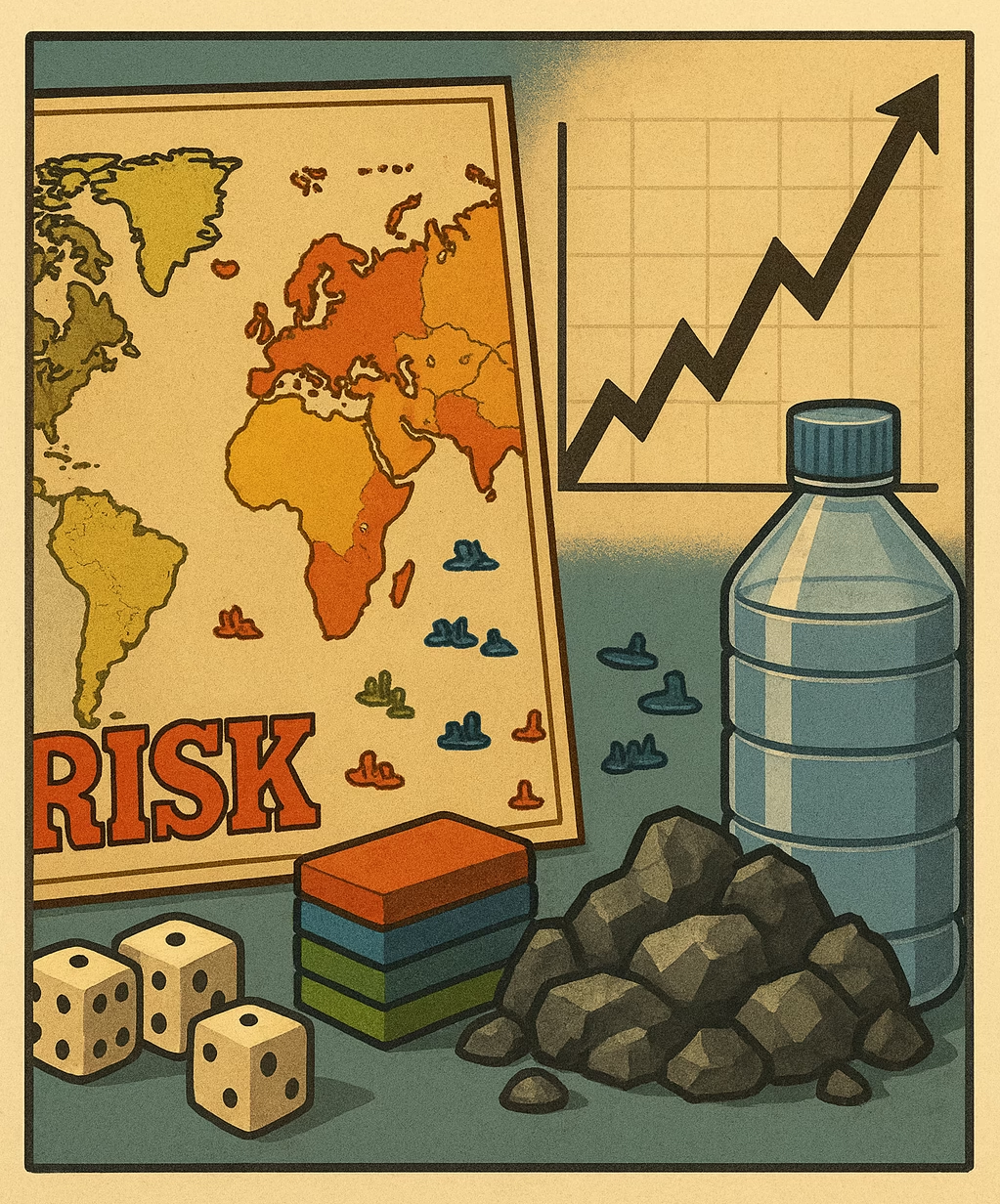
If the twentieth century was defined by oil, the twenty-first will be about water and minerals. Canada sits squarely on top of both. Geography will not protect us from what comes next. We are already a piece in a very real, very dangerous global game of Risk.
The Wars We Already Lived
History offers blunt reminders. In 1973, the OPEC oil embargo left Canadians lining up at gas stations, rationing fuel, and wondering how quickly the world could change. I remember the lineups at gas stations less than I remember how my grocery bill simultaneously went through the roof as supply chains reacted. Suddenly, the cost of a week’s groceries became the loudest reminder that the world beyond our borders had reached into our kitchen.
The Gulf Wars made it explicit: access to oil was worth military intervention. But that was somewhere else. News, yes — but secondary to cost-of-living concerns here at home and the more domestic-focused war of words in Parliament.
Canada sometimes imagined itself buffered. After all, we were energy rich. But our abundance made us a convenient supplier for American priorities, not a sovereign energy power. Washington’s “51st state” joke had an edge—Canada was the neighbour with the gas can.
When Pierre Trudeau introduced the National Energy Policy in 1980, his government tried to assert control: setting domestic pricing, ensuring Canadian supply, and reducing U.S. leverage. The backlash was swift. Alberta bristled, international majors pulled investment, and Conservative governments dismantled much of it. NAFTA later locked in U.S. advantages—guaranteeing access and often at discounted rates.
The pattern repeats. In recent tariff talks, U.S. Ambassador Pete Hoekstra admitted Washington wanted to go further: to reopen CUSMA and fold in critical minerals, defense procurement, even lumber. For now, those ambitions have been shelved. For now.
From Oil to Water and Minerals
Canada holds nearly 20 percent of the world’s freshwater. One in every five glasses of water poured worldwide could, in theory, be Canadian. Beneath our northern shield lie the critical minerals—nickel, lithium, cobalt, rare earths—without which batteries, clean tech, and defense industries falter.
Demand is already fierce. Supply chains strain under the race for lithium and cobalt. Nations from China to the U.S. are investing billions to lock down access. Water scarcity destabilizes regions from California to the Middle East. When aquifers collapse, future wars over pipelines may not carry oil, but water.
The Ring of Fire in northern Ontario contains some of the world’s richest deposits. Yet the majority of mining rights there are held by an Australian corporation. Is that really in Canada’s best interest?
I first heard about Ontario’s Ring of Fire in the late 1970s, long before it had that name. Back then, I was working at a remote hunting lodge when geologists flew in by floatplane, quietly mapping the region’s mineral wealth. Decades later, little has been built, but everything has changed. As I wrote in The Quiet Road North: “The story of the Ring of Fire is no longer just about minerals. It’s about sovereignty, survival, and the quiet determination to protect what can’t be replaced.”
“The story of the Ring of Fire is no longer just about minerals. It’s about sovereignty, survival, and the quiet determination to protect what can’t be replaced.”
Leni spooner, The Quiet road north
That was true when I published it—and it’s even truer now. The minerals of the Ring of Fire are seen as essential for the green tech transition, yet most Canadians don’t realize this debate has been brewing for two generations. What looks like “new news” is really a steady underground current, resurfacing whenever Ottawa or Queen’s Park decides to fast-track development.
The minerals under our feet and the water in our lakes are tied by the same lesson: abundance does not guarantee security. What looks limitless here can, under the wrong rules, become scarce at home.
Canadians may soon face water-saving shower limiters while multinationals export Canadian water at world prices. Imagine paying more for a glass of wine in Thunder Bay than for a glass of water—because scarcity elsewhere, not abundance here, dictates the price.
Decisions Today, Shadows Tomorrow
This may sound like a distant problem—decades away. But decisions made now carve the pathways of our tomorrows.
The Avro Arrow is the cautionary tale. In the 1950s, Canada scrapped its world-leading jet program. We saved money in the short run but lost aerospace independence forever.
I didn’t understand the Arrow’s cancellation at the time, but later—when I first read about how engineers scattered abroad, how blueprints were deliberately destroyed—it hit me like a betrayal. Here was a Canada capable of world-class innovation, and we dismantled it with our own hands. That moment still colours how I view every government promise about “long-term strategy.”
Today, the Canadian Armed Forces remain highly professional but chronically under-equipped. We fly aircraft designed for someone else’s skies, purchased on someone else’s timetable. Sovereignty squandered cannot easily be regained. The Arrow was dismantled, its blueprints destroyed, its engineers scattered abroad. We cannot revive it, no matter how much hindsight wishes it.
Will we make the same mistake with water and minerals—selling off rights, yielding control, assuming abundance guarantees security—until one day we discover those resources are no longer ours to command?
The American Factor
No Canadian story about resources is complete without our southern neighbour. Historically, Washington has viewed Canada not as an equal partner but as a strategic rear.
Trump insists America doesn’t need Canada, yet muses about making us the 51st state. Who takes over something they don’t need? Those who understand redundancy is leverage.
We should not ignore the rhetoric. U.S. presidents have described Canada as a source of drugs, crime, even terrorists “bleeding south.” These are not just campaign flourishes. They normalize the idea that Canadian territory itself is a threat. And history shows what happens when Washington believes a neighbour threatens its security: it acts first, explains later.
These stories are familiar: the neighbour who calls your backyard messy, then insists the cleanup must be done to their specifications, not yours. The neighbour who complains about your weeds, then quietly redraws the fence line. Today’s version: border rhetoric, fentanyl panic, trade grievances—each painting Canada less as a partner and more as a problem.
Rising Vulnerability: From Middle Power to Prize
In the twentieth century, distance from flashpoints and alignment with strong allies insulated us. Those days are ending.
Economic warfare is already being waged. Tariffs in 2025 have nearly tipped Canada into recession. Cyberattacks probe our energy and defense infrastructure. Foreign state-backed enterprises chase our mineral assets. China calls itself a “near-Arctic power.” Russia conducts joint patrols in the North. Military aircraft cross sovereign airspace with increasing frequency—a rare U.S. Boeing E-3 Sentry was spotted over Ottawa and Quebec in September 2025. Such incidents may be training flights, but they feed the uneasy sense that our skies are less impermeable than we assume.
This is the new colonialism—less about planting flags, more about buying stakes, shaping supply chains, rewriting trade rules. Indigenous communities remain first to feel the pressure. Farmers could face drought while water tankers roll south. Northern villages may one day see foreign icebreakers patrolling their shores. And Canada itself may soon learn, first-hand, what Indigenous peoples have lived for centuries under colonial incursions: that sovereignty, once compromised, is hard to reclaim. The tragedy is that Indigenous peoples will go through it all again with us—because we never truly listened, and we never learned.
Preparedness: At a Crossroads
Canada has tightened rules on foreign takeovers and pledged to modernize the Armed Forces. But readiness lags. Personnel shortages, procurement delays, and outdated equipment all leave us exposed.
Cyber defense is now the front line, yet intrusions continue. Tariffs and trade wars can inflict damage without a shot fired. We have always been good at showing up for other people’s fires. The trouble is, we have never stocked the extinguisher for our own.
Visualize the Stakes
Picture it: convoys guarding water pipelines, drones circling cobalt mines, aquifers mapped like treasure troves. Canadians paying global market prices for water beneath their feet. Indigenous lands once again bearing the burden of unchecked extraction. Northern communities shadowed by foreign patrols on melting shipping lanes.
We still sip from full glasses today. But will our grandchildren?
Canadians will always want to focus on housing, groceries, and climate action—and rightly so. But we must also hold both the government and the opposition to account on sovereignty: our natural resources, our intellectual property, our digital security, our trade and defense agreements. We cannot keep pretending that the world’s strife will always be “over there.”
Closing Story: A Game of Risk
When my children were babies, asleep upstairs, my husband and I would stay up until four in the morning playing Risk with a neighbouring couple. Dice rattling across the table, half-empty mugs of coffee cooling while we plotted world domination. We’d stumble into Monday mornings bleary-eyed but convinced we were safe in our little suburban bubble. One morning I woke to the news and thought: Canada is in the middle of a giant game of Risk. I haven’t been able to unsee it since.
The post-WWII era of strong institutions and (mostly) peace is gone. Forever gone is the Canada cushioned by geography. Few alive today have known anything else. It takes little imagination to see how quickly we could become ground zero in a fight over water or minerals. Covid shutdowns will seem quaint compared to the fallout if the U.S., China, and Russia all decide Canada’s resources are too valuable to leave unsecured.
And yet, loopholes still allow foreign organizations to stake claims on Canadian land. Right now, a U.S. non-profit—the National Outdoor Leadership School—has applied to use 77 sites along the B.C. coast as camping stops for its Washington-to-Alaska expeditions. A map of red dots stretches up Vancouver Island and the central coast like a Risk board come to life. The proposal has sparked fierce pushback from coastal communities and the First Nations Leadership Council, which insists consent must be obtained before licences are granted. NOLS has apologized and promised consultation, but the application remains live. Contested is not the same as blocked.
Takeaways: Living in the Condo, Not the Castle
Canada’s comfort zone has long been the theatre of domestic politics. We tend to judge policy on “what does this mean for me now? This year? Next election?” We treat decisions as little more than marks for or against a party’s chance of gaining another mandate.
But Canada is not the world, and the world is not waiting for our election cycle. Sovereignty isn’t just about which political party colour banner is flying over Parliament Hill. It’s about whether we can hold our own when working with others — and whether our leaders see far enough ahead to safeguard what matters.
Canada is not an isolated castle with a moat. We are more like a unit in a global condo: our walls are shared, our security is collective, and our neighbours’ choices spill into our own living rooms. Pretending otherwise is a false comfort we can no longer afford.
That doesn’t mean despair. It means clarity. We can demand that our leaders — blue, red, or orange — be judged not only by their domestic promises but by how they defend our place in a crowded and turbulent world. It means expecting policies that protect both the glass of water on our table and the sovereignty that ensures it stays there.
Hope lies in facing the world as it is, not as we wish it to be. And in remembering that in this twenty-first century game of Risk, we are not powerless players. We still get to choose how Canada plays.
💡 If you found this post valuable, thoughtful, or worth a second read—consider supporting my work with a coffee. Independent analysis takes time, and every bit helps fuel the next deep dive.
👉 Buy Me a Coffee (Thank you—truly.)
💌 If you’ve found this essay thought-provoking, I’d love for you to subscribe to Between the Lines.
Subscribers get essays, digests, and occasional deep-dives exploring Canada’s shifting political, economic, and cultural landscape — all written in a calm, kitchen-table voice.
It’s free to sign up, and subscribers directly support the sustainability of this work.
About the Author
Leni Spooner is a Canadian writer, researcher, and civic storyteller. She is the founder of Between the Lines | Kitchen Table Politics, a longform publication exploring how policy, economics, food systems, and everyday life intersect. Her work blends historical context with present-day analysis, helping readers see the deeper patterns that shape Canada’s choices — and the lives built around them.
If you enjoy thoughtful, independent writing, you can:
👉 Subscribe to Between the Lines to receive updates and new essays
👉 Buy Leni a coffee to support this work
Citations
- Critical Minerals – Natural Resources Canada. The Canadian Critical Minerals Strategy (updated 2023).
https://natural-resources.canada.ca/our-natural-resources/minerals-mining/critical-minerals - Canada’s Freshwater Resources – Statistics Canada. Freshwater in Canada (2022).
https://www150.statcan.gc.ca/n1/pub/16-201-x/2011001/part-partie2-eng.htm - Avro Arrow Cancellation – Canada Aviation and Space Museum. The Avro Arrow (archival overview).
https://ingeniumcanada.org/aviation/artifacts/avro-arrow - National Energy Program (NEP) – Canadian Encyclopedia. National Energy Program (1980–1985).
https://www.thecanadianencyclopedia.ca/en/article/national-energy-program - NAFTA Energy Provisions – Government of Canada. North American Free Trade Agreement (archived), Chapter 6 (Energy).
https://www.international.gc.ca/trade-commerce/trade-agreements-accords-commerciaux/agr-acc/nafta-alena/chap6.aspx?lang=eng - CUSMA Expansion Talks – CBC News. U.S. seeks to broaden scope of CUSMA talks, says ambassador (July 2025).
https://www.cbc.ca/news/politics/us-ambassador-to-canada-disappointed-anti-american-campaign-1.7637534 - Trump on Greenland – ABC News. Trump says US should ‘go as far as we have to go’ to gain control of Greenland (March 2025).
https://abcnews.go.com/International/trump-us-control-greenland/story?id=120208823 - Coast Guard Integration – Government of Canada. National Defence welcomes the Canadian Coast Guard to the Defence Team (Sept 2025).
https://www.canada.ca/en/department-national-defence/news/2025/09/national-defence-welcomes-the-canadian-coast-guard-to-the-defence-team.html - US Aircraft over Ottawa/Quebec – Yahoo News Canada. Plane-watchers report seeing U.S. military surveillance aircraft over Ottawa, Quebec (Sept 2025).
https://ca.news.yahoo.com/plane-watchers-report-seeing-u-080000547.html - NOLS 77 Sites Controversy – CBC News. U.S. outdoor group’s application to use B.C. land sparks debate amid 51st state talk (Sept 2025).
https://www.cbc.ca/news/canada/british-columbia/nols-bc-land-application-controversy-1.7264825