By Leni Spooner, creator of Between the Lines.
If you live in Canada, you’re almost certainly part of the Loblaw ecosystem — whether you like it or not. You might shop at No Frills or Real Canadian Superstore. Maybe you pick up your prescriptions at Shoppers Drug Mart. Your kids’ jeans could be from Joe Fresh, your weekly flyer points stacking up on PC Optimum, and your credit card branded PC Financial. One parent company — Loblaw, owned by the Weston family — has managed to thread itself through almost every stage of Canadian life.
And that’s not an exaggeration.
The Empire in Plain Sight
Loblaw isn’t just a grocery store chain. It’s a cradle-to-grave empire that has been expanding its reach for more than a century. From the early 20th-century promise of self-serve shopping, it has grown into a corporation that controls nearly one-third of Canada’s grocery market. Today, it operates more than 2,500 stores across the country, capturing an estimated two billion transactions every year.
Its reach is staggering:
- Grocery chains: Loblaw, No Frills, Zehrs, Fortinos, Independent, Real Canadian Superstore, Maxi, Provigo, T&T.
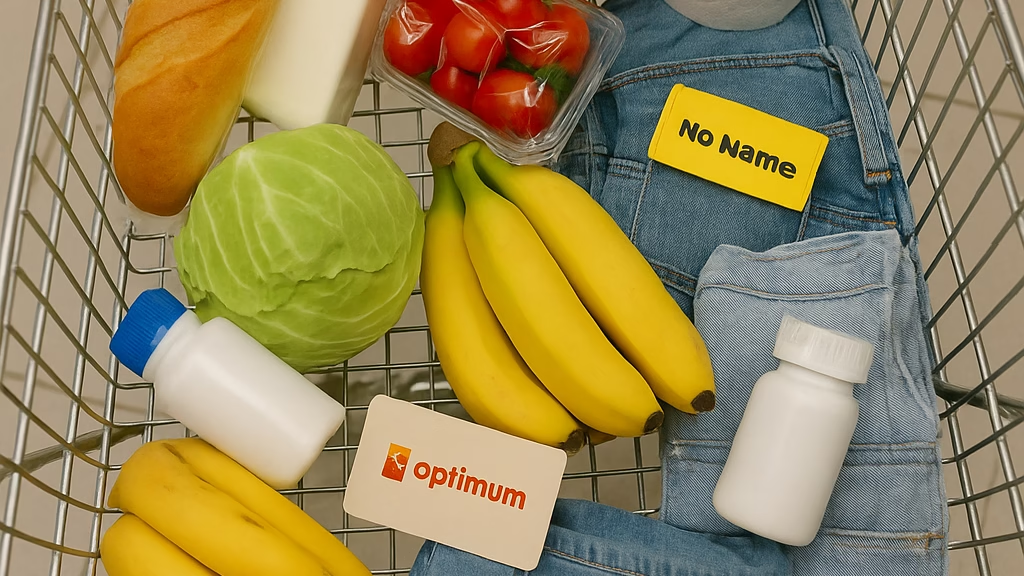
- Household brands: President’s Choice, No Name, Life, Joe Fresh.
- Health care: Shoppers Drug Mart pharmacies, telemedicine through Maple, and dozens of for-profit medical clinics.
- Finance & data: PC Financial credit cards, with over 3 million users; PC Optimum loyalty program, tracking the purchases of 18 million Canadians. Assuming Canada’s children aren’t holding loyalty cards, it’s safe to say Optimum is tracking nearly every household in the country.
- Real estate: Through its Choice Properties REIT, Loblaw also holds sway over the commercial spaces its competitors might otherwise move into.
It is almost impossible to avoid. Loblaw boasts that 90 percent of Canadians live within ten kilometres of one of its stores.
The Price of Convenience
To hear the company tell it, this is all about efficiency and convenience: one-stop shopping, rewards programs, consistent prices. But here’s the catch: when a company has this much control, “efficiency” too often translates into higher margins for shareholders and fewer choices for consumers.
The results speak for themselves:
- In 2023, Loblaw reported $14.53 billion in fourth-quarter revenue and $541 million in profit.
- Over the same period, Canadian households faced the steepest food inflation in decades — groceries were up 11.4% in 2022 and 7.8% in 2023 (StatsCan).
- A Dalhousie University Agri-Food Lab survey found that over 60% of Canadians believe grocers are profiteering from inflation, not just passing along higher supplier costs.
We’ve seen the pattern before:
- The bread price-fixing scandal in 2017.
- The cancellation of “hero pay” bonuses for frontline workers during the pandemic.
- Cutting the discount on expiring food from 50 percent down to 30 — until public outrage forced a reversal.
- The proposed deal with Manulife that would have forced prescription drug coverage exclusively through Loblaw-owned pharmacies, dropped only after a consumer backlash.
These aren’t accidents. They’re what happens when a company knows you can’t easily walk away.
Why Competition Matters
Any economist will tell you: lack of competition makes it easier for companies to raise prices. Loblaw’s quarterly reports confirm this — not just higher profits, but higher profit margins.
Contrast this with other jurisdictions:
- Germany & the UK: Discount chains Aldi and Lidl aggressively undercut giants, forcing everyone else to keep margins razor thin. Grocery markups average 2–3%, compared to Canadian grocers’ 5–7%.
- United States: Walmart dominates, but it competes against Kroger, Costco, and regional chains. The Federal Trade Commission under Lina Khan has ramped up scrutiny of mergers and predatory practices.
- Australia: The Coles/Woolworths duopoly mirrors Canada’s problems. With weak competition law, food prices are inflated and smaller independents squeezed out.
Canada? We joke about being “three companies in a trench coat,” but it isn’t really a joke when it comes to essentials like food.
The Role of Provinces
Here’s something often overlooked: provinces hold the real levers. Under Confederation, they control consumer protection, retail licensing, and health care delivery. That means provinces could — if they chose — put up guardrails against Loblaw’s expansion into medical services, or limit restrictive real estate practices that box out competitors.
Instead, too often, they enable the growth. Ontario in particular green-lit Shoppers Drug Mart’s push into clinical services, effectively sanctioning a deeper merger of retail and health care.
Quebec has historically pushed harder against monopolization (protecting independent pharmacies, for example). But even there, Loblaw banners like Provigo and Maxi dominate shelf space.
If the federal government wants to talk nation-building, it can’t dodge this. But neither can provincial governments. And neither can we as consumers.
Consumer Pushback Works — Sometimes
It’s easy to feel powerless. Yet Canadians have forced course corrections before:
- Public anger over expiry-food discounts pushed Loblaw to reinstate the 50 percent markdown.
- The Manulife prescription drug deal collapsed under consumer and expert criticism.
- The bread scandal forced grocers into public apologies and legal settlements.
These wins didn’t undo concentration of power. But they proved one thing: organized consumer outrage still works.
From Cradle to Grave
Consider a typical Canadian life:
- Newborn: formula, diapers, and wipes from Shoppers.
- Childhood: lunch snacks from No Name, clothes from Joe Fresh.
- Young adult: PC Financial Mastercard, groceries from No Frills.
- Parent: Zehrs or Superstore for weekly shopping, Shoppers for meds, PC Optimum for loyalty points.
- Senior: Telehealth through Maple, prescriptions from Shoppers, maybe even funeral flowers from Loblaw’s floral arm.
From cradle to grave, you’re inside the ecosystem. And your data — health, financial, and consumer — is being harvested at every stage.
Why This Story Matters
This isn’t just about one grocery chain. It’s about whether Canadians want to live in a country where a single company can dictate the price of bread, the cost of medicine, the clothes on your kids’ backs, and even where rivals are allowed to set up shop.
Nation-building is not just pipelines and housing projects. It’s ensuring that no single corporate empire dominates daily life. And that requires both government intervention and consumer resistance.
Because if Canadians shrug and swipe the Optimum card, the Weston–Loblaw trench coat wins.
And if we don’t push back? Loblaw won’t just be where we shop.
It will be the air we breathe.
💌 If you’ve found this essay thought-provoking, I’d love for you to subscribe to Between the Lines.
Subscribers get essays, digests, and occasional deep-dives exploring Canada’s shifting political, economic, and cultural landscape — all written in a calm, kitchen-table voice.
It’s free to sign up, and subscribers directly support the sustainability of this work.
👉 Subscribe here to Between the Lines — pull up a chair, there’s always room for one more.
💡 If you found this post valuable, thoughtful, or worth a second read—consider supporting my work with a coffee. Independent analysis takes time, and every bit helps fuel the next deep dive.
👉 Buy Me a Coffee (Thank you—truly.)
About the Author
Leni Spooner is a Canadian writer, researcher, and civic storyteller. She is the founder of Between the Lines | Kitchen Table Politics, a longform publication exploring how policy, economics, food systems, and everyday life intersect. Her work blends historical context with present-day analysis, helping readers see the deeper patterns that shape Canada’s choices — and the lives built around them.
If you enjoy thoughtful, independent writing, you can:
👉 Subscribe to Between the Lines to receive updates and new essays
👉 Buy Leni a coffee to support this work