
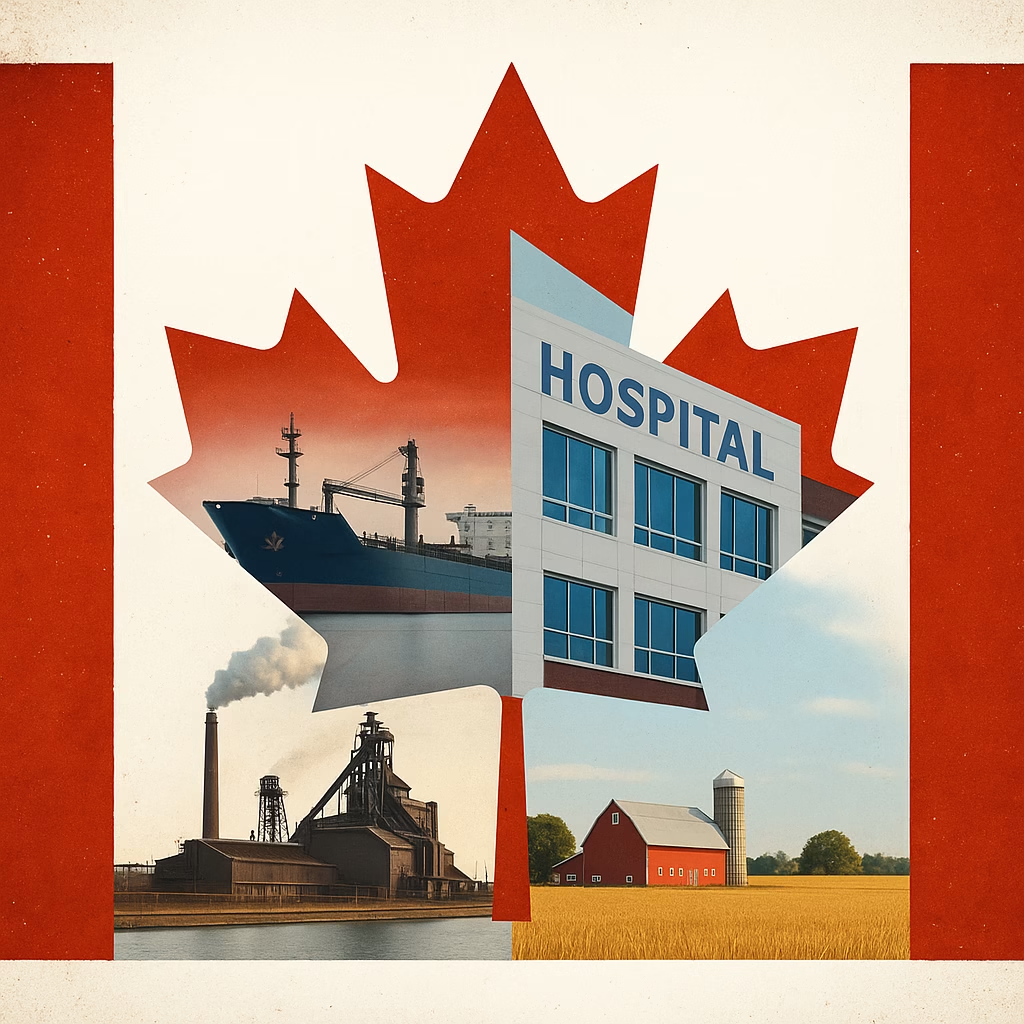
Rethinking nation-building beyond steel and defence to include care, communities, and food sovereignty
By Leni Spooner, creator of Between the Lines.
Canadian opposition parties should be telling this story. Digging into real policy depth discussions about what is and isn’t on the table. Instead of sharp one-liners for Question Period, Canadians deserve a debate about how Keynesian spending could be balanced between ships and steel, and the equally urgent needs in classrooms, hospitals, and farms.
Keynesian Defence Strategy
It’s not often that Canadians hear “Keynesian defence strategy” tossed around in casual political talk. Yet that’s exactly what’s happening now. Ottawa, facing the reality of Washington’s reshoring push and waves of tariffs, has started to frame military procurement and industrial capacity as both sovereignty and stimulus. Billions are being spent on ships, jets, and aerospace contracts not only to defend our borders but to defend Canadian jobs.
There’s a logic to it. When the U.S. sneezes, Canada catches pneumonia. When tariffs hit, as Hamilton has been reminded, the shock can reverberate across whole communities. Ottawa wants to show that it has a plan — Keynesian-style spending to buffer the blow and keep Canadians employed.
But here’s the imbalance: ships and steel are elevated as “nation-building,” even as hospitals, classrooms, and the vast unpaid labour that sustains our care economy are sidelined. These, too, are engines of GDP, but they don’t seem to merit the same urgency in federal–provincial strategy. The silence isn’t just puzzling. It’s dangerous.
Hamilton at the Centre of Canada’s Nation-Building Strategy
Hamilton, Canada’s historic steel city, has once again become the face of economic stress. With Washington now imposing 50% tariffs on Canadian steel and aluminum, Hamilton’s industrial base — and the supply chains around it — have been thrown into jeopardy. The ArcelorMittal Dofasco plant — long a cornerstone of the city’s identity and one of its largest employers — has become the symbol of this latest trade battle.
Economists estimate that as many as 42,000 jobs in Hamilton alone are at risk from this trade war. The first tangible cut came earlier this summer, when a wire-drawing mill shut down, putting 153 workers out of a job. Politicians of every stripe scrambled. Sovereignty was invoked. Ottawa promised aid, adjustment, and new contracts.
This is the reflex Canadians have come to expect: when “hard” industry is threatened, the state rushes in. Keynesian defence spending — targeted investments in steel, aerospace, shipbuilding — becomes not just economic strategy but a predictable political reflex. The message is clear: when Hamilton trembles, the nation trembles.
But when nurses strike? When classrooms overflow? The urgency fades.
The Care Economy in Canada’s Nation-Building Strategy
Health and education are treated as “provincial responsibilities” — a convenient way for Ottawa to duck. But by any measure, they are national economic engine contributors.
- Healthcare: In 2024, healthcare accounted for 12.4% of Canada’s GDP, the highest level ever recorded.
- Education: Roughly 5.2% of GDP is tied to educational services.
By comparison, all of manufacturing, construction, and natural resources combined contribute about 26%, while defence spending remains just a sliver — projected to reach only 1.37% of GDP in fiscal year 2024-25. Defence is barely a rounding error beside health and education, yet it receives disproportionate attention in national debates.
Together, health and education employ millions of Canadians and shape labour force participation for decades to come.
And that’s just the paid economy.
The unpaid care economy is even bigger. Statistics Canada has estimated the value of unpaid household and care work at between $517 billion and $860 billion in 2019. Using a “foregone wages” calculation, that’s a staggering 37.2% of GDP. Even the conservative replacement-cost method puts it at 25.2% of GDP — larger than manufacturing, wholesale, and retail combined.
Think about that for a moment. The economy Canadians actually live inside — caring for children, supporting aging parents, keeping households functioning — is bigger than most of the sectors Ottawa rushes to protect. Yet it is invisible in national strategy.
When steel falters, it’s a sovereignty crisis. When care falters, it’s a provincial budget line.
Buck-Passing Weakens Canada’s Nation-Building Strategy
One of the reasons this imbalance persists is structural. Ottawa insists it has no authority over health and education; provinces jealously guard their turf. And it’s true: provinces deliver the services. They manage hospitals, staff schools, negotiate labour contracts.
But Ottawa isn’t powerless. Far from it. The federal government holds the fiscal levers. It can attach conditions to transfers. It can establish national frameworks, as it did with Medicare in the 1960s and more recently with childcare agreements. It can choose to treat healthcare and education as nation-building projects, not just cost-shared obligations.
Instead, the two levels of government play a familiar game of buck-passing: Ottawa shrugs and blames the provinces; provinces demand more money with no strings; citizens are left with the bill — often paid in unpaid labour, when hospitals overflow or when families patch together eldercare at home.
This is not just an inconvenience. It is a structural drag on the economy. When workers are pulled out of the labour force to provide unpaid care, productivity and participation both suffer. Yet these losses rarely figure in the debates over sovereignty and nation-building.
Canada’s Nation-Building Strategy for the 21st Century
What counts as “nation-building” is, at its core, a political choice. In the mid-20th century, Canada chose to build railways, highways, aerospace capacity — and Medicare. Each was a Keynesian intervention. Each reshaped the economy.
Today, Ottawa seems willing to mobilize Keynesian defence spending to shore up industrial capacity in the face of U.S. reshoring. But it remains silent on care.
This is a false distinction. Sovereignty does not only live in naval fleets and steel mills. It lives in whether Canadians can get emergency care when they need it. It lives in whether classrooms can equip the next generation. It lives in whether unpaid care labour is recognized as infrastructure, not invisible filler.
Farming and the Missing Middle in Canada’s Nation-Building Strategy
There’s another crucial layer to this story—one deeply tied to food sovereignty. Canada’s growing reliance on urban cores isn’t incidental; it’s the result of decades of neglect.
- From 2001 to 2021, Canada lost more than 13 million acres of farmland—the equivalent of seven small farms disappearing every single day.
- In Ontario alone, farmland has shrunk by 50% since 1941, with more than 1.5 million acres lost between 1996 and 2016 to urban sprawl.
This erosion has eroded what remained of the “missing middle” in food infrastructure. Small processors, abattoirs, storage hubs, and regional services have steadily disappeared under consolidation. Farmers can still grow food, but without the mid-sized processors and local facilities that connect them to markets, too much value is siphoned away or forced into corporate supply chains.
Canada still counts nearly 189,900 farms nationwide, and about 97% are family-owned and operated. That foundation is still there, but it is fragile — and without rebuilding the middle layer of infrastructure, it risks slipping away.
Canada’s food and beverage processing sector includes nearly 8,800 establishments, and 92% of them employ fewer than 100 people. It’s a fragile landscape of small and mid-sized players, not a fortress of giants. Meat processing alone generates over $24 billion in sales, employs almost 70,000 Canadians, and makes up 12% of Canada’s agri-food exports. Yet despite this scale, the steady closure of local abattoirs and processors has left farmers with fewer options and consumers more dependent on imports and corporate grocers.
The result is predictable: people crowd into big cities for work and services, putting unbearable strain on hospitals, classrooms, transit, and housing. Meanwhile, regional economies stagnate.
If Ottawa is serious about Keynesian nation-building, it cannot stop at shipyards. Investing in regional farming economies—processing plants, rural healthcare, education hubs, even local abattoirs—would not only bolster food sovereignty but also ease the pressure on urban centres and make smaller communities viable.
This isn’t “nice-to-have” policy. It is nation-building. By rebuilding the missing middle, Canada can strengthen both food and care sovereignty—while finally giving overstretched cities a pressure relief valve.
Citizen Pressure and Canada’s Nation-Building Strategy
None of this will shift without pressure from Canadians. And here’s the critical point: citizens must push at all three levels of government.
- Federal MPs need to hear that healthcare, education, farming infrastructure, and regional development must be treated as nation-building priorities, not just defence and steel.
- Provincial MPPs/MLAs need to hear that “provincial responsibility” is not a shield for underinvestment. If provinces want more federal dollars, they must accept frameworks and deliver results.
- Municipal councils and mayors need to hear that local decisions on zoning, land use, infrastructure, and service delivery cannot simply cater to developers or short-term budgets. Municipal governments control much of the land planning that determines whether farmland is paved over or protected, whether hospitals and schools can expand, and whether small towns remain viable.
The history of Medicare offers the precedent. It was not delivered by politicians alone; it was won through public demand and citizen activism. Canadians insisted on it until it became a national reality.
We need that same energy now — federally, provincially, and municipally. Citizens can’t leave this to Ottawa or the provinces alone: municipal governments are where many of the most decisive choices get made.
Conclusion
Canada’s nation-building strategy cannot stop at shipyards. If we can rally billions for ships and mills, we can rally the same urgency for nurses, classrooms, and regional farming economies. Canada knows how to mobilize Keynesian economics when Washington rattles our industrial foundations. Hamilton’s steel sector proves it. But if we can rally billions for ships and mills, surely we can rally the same urgency for nurses, classrooms, and regional farming economies.
Because sovereignty isn’t just a matter of defending our borders. It’s about whether Canadians can get care, whether rural communities can thrive, and whether our children inherit a country with both industrial and human resilience.
Unpaid care labour already makes up a third of our GDP. That’s not invisible. That’s infrastructure. And if we keep ignoring it, we do so at our peril.
It’s time to demand a new definition of nation-building: one that treats ships, steel, staff, and farms as equal pillars of Canada’s future.
Closing Thoughts
Opposition politics in Canada has too often become a theatre of one-liners. What’s missing is substance — a clear vision that challenges the government to invest not only in military and industrial capacity, but also in the care economy, regional farming, and the resilience of our communities.
This essay is the kind of narrative I wish our opposition leaders were putting on the table, instead of trading barbs that vanish with the news cycle. But here’s where you come in: if you agree that these are the kinds of conversations our governments and pundits should be having, then make them part of your own kitchen-table and community conversations. Talk with family, friends, and neighbours about what nation-building really means.
And just as importantly, reach out to your elected representatives — not only MPs and MPPs/MLAs, but also your local councillors and mayors. Let them know that sovereignty is about more than steel and ships. It’s about care, community, and the infrastructure that holds us together.
Change begins when these conversations start at the grassroots — around kitchen tables, in community halls, and at local councils — and then press upward through city halls, provincial legislatures, and Parliament. And when those decisions circle back down into classrooms, hospitals, and main streets, Canadians can see the proof that their voices mattered.
Further Reading & Sources
- Statistics Canada. Unpaid Household Work in Canada, 2015 and 2019. The Daily, March 17, 2022.
https://www150.statcan.gc.ca/n1/daily-quotidien/220317/dq220317b-eng.htm - Statistics Canada. Canadian Agriculture at a Glance: Farms, Farmland and Farm Operators, 2021 Census of Agriculture. August 25, 2023.
https://www150.statcan.gc.ca/n1/daily-quotidien/230825/dq230825a-eng.htm - Agriculture and Agri-Food Canada. Overview of the Food and Beverage Processing Industry. Government of Canada, 2024.
https://agriculture.canada.ca/en/sector/food-processing-industry/overview-food-beverage - Bonnefield Financial. Canadian Farmland Insights: 2023 Q2 Newsletter. June 28, 2023.
https://bonnefield.com/2023/06/28/bonnefield-newsletter-q2-2023 - Frontiers in Sustainable Food Systems. Ontario Farmland Loss: Drivers and Policy Responses. 2022.
https://www.frontiersin.org/articles/10.3389/fsufs.2022.777816/full - Canadian Meat Council. Industry Overview.
https://en.wikipedia.org/wiki/Canadian_Meat_Council - Department of National Defence (Canada). 2024–25 Supplementary Estimates.
https://www.canada.ca/en/department-national-defence/corporate/reports-publications/proactive-disclosure/supplementary-estimates-dnd-caf-21-nov-2024/spending.html - Politico. Canada’s Defence Spending to Hit 1.37% of GDP in 2024–25. April 19, 2025.
https://www.politico.com/news/2025/04/19/mark-carney-unveils-plan-to-trump-proof-canada-00299654 - White House (U.S.). Fact Sheet: President Donald J. Trump Increases Section 232 Tariffs on Steel and Aluminum. June 4, 2025.
https://www.whitehouse.gov/fact-sheets/2025/06/fact-sheet-president-donald-j-trump-increases-section-232-tariffs-on-steel-and-aluminum
About the Author
Leni Spooner is a Canadian writer, researcher, and civic storyteller. She is the founder of Between the Lines | Kitchen Table Politics, a longform publication exploring how policy, economics, food systems, and everyday life intersect. Her work blends historical context with present-day analysis, helping readers see the deeper patterns that shape Canada’s choices — and the lives built around them.
If you enjoy thoughtful, independent writing, you can:
👉 Subscribe to Between the Lines to receive updates and new essays
👉 Buy Leni a coffee to support this work
💡 If you found this post valuable, thoughtful, or worth a second read—consider supporting my work with a coffee. Independent analysis takes time, and every bit helps fuel the next deep dive.
👉 Buy Me a Coffee (Thank you—truly.)
💬 Join the Conversation
If this piece resonated with you—or raised new questions—I’d be grateful if you shared it, left a comment, or passed it along to someone who’d value the read. Between the Lines grows one thoughtful reader at a time, and your voice is part of that.