
Previously, in A Quiet Reckoning
In Chapter 1, Introduction + Past Is Prologue, we looked back to Canada’s Centennial moment — a time when optimism rolled across the country on the rails of the 1967 Confederation Train. It was an age of confidence, when we believed in building: libraries, parks, hospitals, and a national story big enough for everyone.
But that momentum faded. Canada’s boldness gave way to caution, and the habit of building slipped quietly out of view.
Now, as the country again talks of “Building Canada Strong,” Chapter 2 asks what it really means to build for peace — not just in spirit, but in concrete, cable, and care.
What the Cold War Was
The Cold War wasn’t a single war but a forty-year standoff between two worldviews — the U.S. and its allies on one side, the Soviet Union on the other. Both had nuclear weapons powerful enough to destroy the planet, so they fought for influence instead of territory: through espionage, propaganda, and proxy wars.
For Canada, it was less about confrontation than cooperation — using our geography to guard the Arctic, share radar and intelligence, and prove that peace could be built through infrastructure as much as deterrence.
The Infrastructure of a Quiet Power
Canada didn’t just inherit peace after the Second World War—we had to build it. Quietly, and at scale.
By the 1950s, the war was over but the world was not at rest. As East and West solidified into opposing blocs, Canada found itself in a new kind of role. No longer just a junior partner in Britain’s wars or a helpful North Atlantic neighbour, we became something stranger: a keystone in the global architecture of nuclear deterrence. Not because of ambition. But because of geography.
The threat wasn’t land invasion—it was air. It was missiles. It was over-the-pole flight paths and five-minute warning clocks. And so Canada, with its vast Arctic frontier and its deep northern silence, became a buffer zone. A tripwire. A surveillance state before surveillance was even a word people used.
The Cold War gave Canada a front-row seat in a battle no one wanted to start. And what did we do?
We built.
But not just weapons. Not just bases. We built systems.
The Quiet Hardware of Defence
Long before we ever debated meeting NATO’s 2% spending target, Canada was laying down concrete and cable for a different kind of military presence—one designed for cooperation, not conquest.
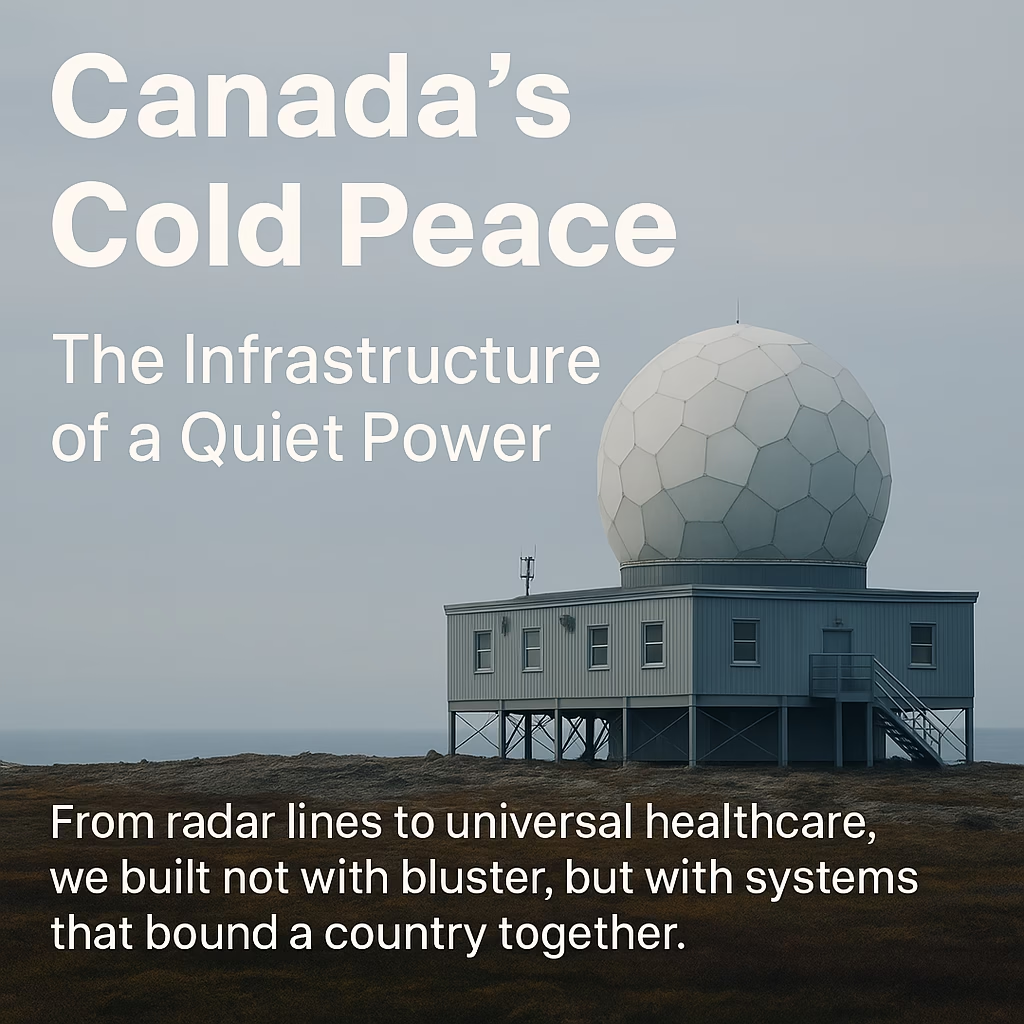
We helped design and host the Pinetree Line, a network of radar installations stretching across southern Canada. When that proved inadequate, we helped fund and man the Mid-Canada Line, and later the Distant Early Warning Line (DEW Line)—a chain of Arctic radar sites built beginning in 1957 to spot Soviet bombers before they crossed the pole. These installations were technical marvels, built in remote conditions by engineers, Inuit guides, and servicemen. Some of these sites lasted barely a decade. But what they represented was lasting: a commitment to interoperability. A willingness to let geography shape our role in the world.
Then came NORAD, formalized in 1958. A binational agreement with the United States that merged continental air defence planning. It gave Canada prestige—and also blurred the lines of sovereignty. We were hosting American fighter squadrons, coordinating joint radar systems, and standing ready to respond to threats on behalf of two nations, not just one.
To some, it looked like we were giving up control. But to most Canadians, it felt like pragmatic alliance-building. A way to matter. A way to manage our vulnerabilities through cooperation.
And yet even this wasn’t the whole story.
Because while NORAD, radar lines, and the cancelled Avro Arrow made headlines, something else was quietly being built under the radar—something more foundational.
The Other Kind of Infrastructure
In the same decade that we were carving runways out of permafrost, we were also building hospitals. While radar dishes turned northward, school boards expanded southward. And as command centres rose out of boreal forest, Parliament debated how to make healthcare a universal right.
In 1957, the Hospital Insurance and Diagnostic Services Act introduced federal- provincial cost-sharing for universal hospital care. By 1961, every province had joined.
In 1966, the Medical Care Act was passed, extending the model to physician services. The rollout continued through the early 1970s.
By 1972, every province and territory had joined. And it wasn’t just healthcare.
- The Canada Pension Plan (1966).
- The Guaranteed Income Supplement (1967).
- Post-secondary expansion.
- Student loans.
- Veterans’ housing and benefits reform.
- Employment insurance overhaul.
Much of what we now call the Canadian social contract was born during these years— the same years we were helping the U.S. track Soviet bombers from across the Arctic.
Why It Matters
This parallel build-up wasn’t a contradiction. It was a strategy.
Canada chose not to meet the Cold War moment with bluster, but with infrastructure. We built not only to protect territory, but to bind it. Not only to resist invasion, but to resist division.
This wasn’t accidental. The architects of postwar Canada understood that a nation as vast and underpopulated as ours would always be vulnerable to fracture. So we built the roads, the rails, the hospitals, the radars, and the benefit programs together—as one, interconnected system.
Defence didn’t just mean fighter jets and radar lines. It meant trust. It meant access. It meant coherence. Universal Healthcare was a soft-power shield against instability. The Canada Pension Plan was economic infrastructure. The DEW Line and the Guaranteed Income Supplement were, in their own ways, both tools of national security.
It wasn’t cheap. It wasn’t flashy. But it worked.
A Cold Peace with Warm Intent—But Uneven Reach
The postwar decades shaped a Canada that saw security as more than surveillance. In that, we were ahead of our time. While other nations dug trenches, we poured foundations.
But not everywhere. And not for everyone.
Much of that social and physical infrastructure—hospitals, highways, pensions, protections—was built where the population already was: in the southern half of the country, in the corridors between major cities, and in the temperate zones where logistics were easier and economies stronger.
The farther north you went, the thinner the contract became.
Northern communities—especially Indigenous communities—were not equal partners in this build-up. Many were deliberately excluded from decision-making. Others were actively displaced by megaprojects. Some were promised services that never came. Even today, large swaths of northern Canada remain underserved or entirely disconnected. Roads are seasonal. Internet is unreliable. Healthcare access is limited. Water advisories persist in places where radar towers once stood tall.
We built radar stations before we built clean water systems.
That contradiction sits at the heart of Canada’s quiet buildup: a country ambitious enough to monitor the skies above the Arctic, but still struggling—decades later—to ensure reliable school access, medical transport, or broadband in the same regions.
And that’s what makes the current push to “build out the North” so ambitious, so urgent, and so long overdue. The social contract we once imagined must now be expanded—repaired—into the vast regions we long ignored, even as we relied on them strategically.
We didn’t just choose peace. We chose preparedness.
But we did not extend it to all.
And now, in the face of new geopolitical pressures, we must confront the unfinished work of that Cold Peace: to build a resilient, modern, connected Canada—in full.
← Return to Series Home
☕ Support independent Canadian storytelling → Buy Me a Coffee
📘 Own the full book → A Quiet Reckoning on Gumroad — or get the complete ebook (PDF edition) free with a paid Substack subscription.
🕊️ Discuss this chapter in the comments or share your own memories of Canada’s building years.
About the Author
Leni Spooner is a Canadian writer, researcher, and civic storyteller. She is the founder of Between the Lines | Kitchen Table Politics, a longform publication exploring how policy, economics, food systems, and everyday life intersect. Her work blends historical context with present-day analysis, helping readers see the deeper patterns that shape Canada’s choices — and the lives built around them.
If you enjoy thoughtful, independent writing, you can:
👉 Subscribe to Between the Lines to receive updates and new essays
👉 Buy Leni a coffee to support this work
💌 If you’ve found this essay thought-provoking, I’d love for you to subscribe to Between the Lines.
Subscribers get essays, digests, and occasional deep-dives exploring Canada’s shifting political, economic, and cultural landscape — all written in a calm, kitchen-table voice.
It’s free to sign up, and subscribers directly support the sustainability of this work.