
Series Navigation
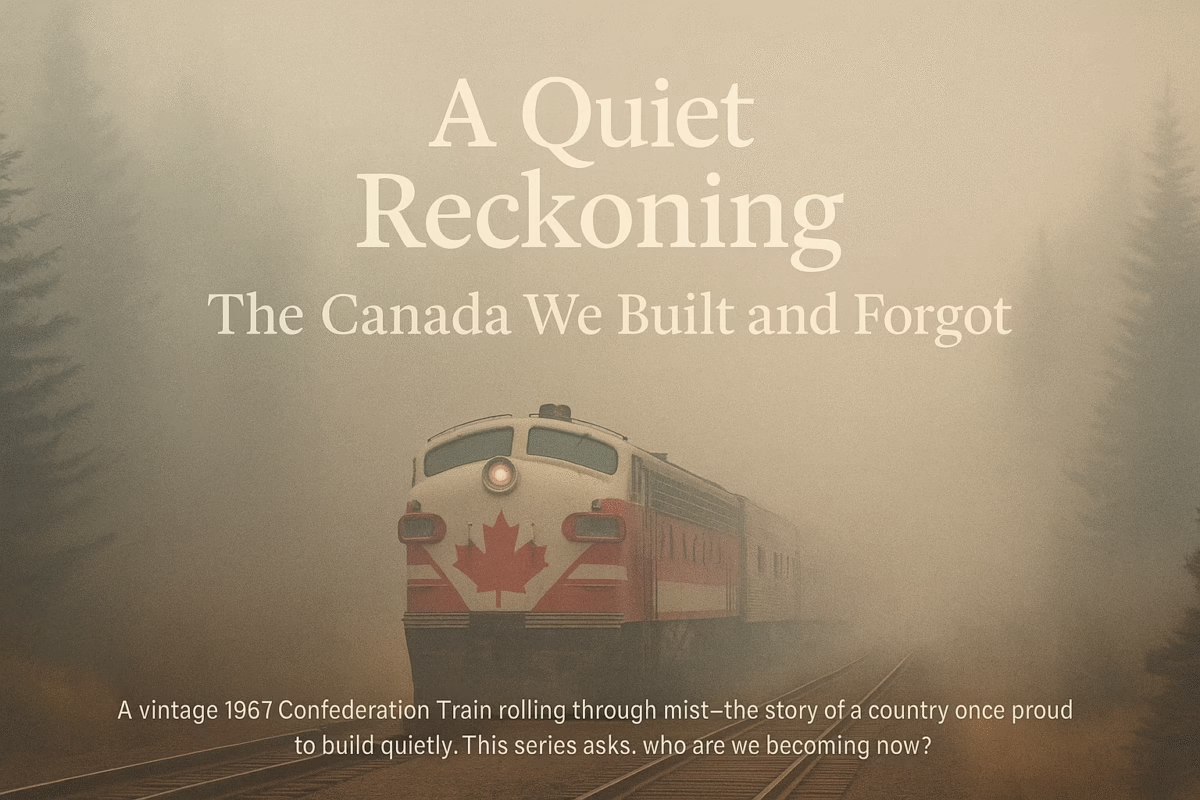
Part of the ongoing series A Quiet Reckoning: The Canada We Built and Forgot
← Series Home | Next → Chapter 2 Canada’s Cold Peace
Introduction
Quiet Builder
What Canada Built … And Left Behind
Beneath the surface of Canadian politics, something has been shifting.
While louder nations redraw alliances and ramp up their military postures, Canada has taken a quieter route — slower, sometimes halting, but not without purpose.
This book traces an evolving strategy. Not just in defence, but in infrastructure, diplomacy, logistics, and national resilience. What began as a series about military readiness grew into something broader: a portrait of how a country both builds and forgets to build — and what that means for sovereignty in the 21st century.
This is not a history book. It is a context narrative. It offers no fixed destination, only a compass: pointing toward patterns in policy, institutional capacity, and the long consequences of quiet decisions. It’s a reading of budgets, alliances, supply chains, and shifting political will.
It’s also a reminder that Canada doesn’t exist in isolation. The forces reshaping this country — economic fragmentation, infrastructure strain, digital dependency, climate change — are playing out across much of the developed world. Variants of Canada’s struggle exist in the United States, the UK, and across Europe. What sets us apart is how we respond — and who we choose to become in the process.
Use this ebook as a filter. A reference point. A way to assess the current federal mandate not just by headlines, but by trajectory. And when the next writ drops — federally, provincially, or municipally — let’s not judge by slogans alone. Let’s recall the deeper story: of what was built, what was dismantled, and what was quietly left unfinished.
Echoes of a Quiet Buildup
by Leni Spooner
I was a child in Canada’s first century, standing at the edge of a crowd as the Confederation Train rolled into town.
I don’t remember the speeches. I don’t even clearly recall what was inside each car. But I remember the feeling.
It was 1967. We had a brand-new flag. A world’s fair was rising in Montreal. And in front of me was a train made of history and hope.
Car by car, the story of Canada unfolded — Indigenous beginnings, settler struggles, industrial dreams, wartime sacrifices, and the big idea of a country becoming itself.
I walked through every car, again and again. I couldn’t get enough Canada.
Each display sparked my imagination. Each one filled me with pride, joy, and a deep sense of wonder. Because even as a child, I somehow knew: what came before mattered. And what came next could be just as extraordinary.
We were twenty million strong, full of confidence, full of momentum. We weren’t afraid to build. We weren’t afraid to dream. Our new maple-leaf flag was as bold and beautiful as the country it represented.
I didn’t understand it all then. I was too young. But children always feel what adults try to contain: that rising wave of hope and possibility.
Canada was moving. Projects were springing up everywhere — parks, libraries, stadiums, swimming pools — all proudly stamped with the word Centennial.
Even our music was changing. There was a new song — “Ca-na-da!” — and kids like me sang it on the radio and in school assemblies. We didn’t think of it as branding or policy. But looking back, it was both.
That train wasn’t just a museum. It was a moving narrative. A quiet build-up of national identity, brought right to our doorstep.
But that was then.
As I grew up, I watched the momentum fade. Canada began to lean back. The optimism of the Centennial years gave way to caution — and eventually to austerity. Recessions followed. Priorities shifted. And the bold projects of the past began to fade from memory.
Until now.
Because in 2025, I feel it again.
It’s quieter this time — no parades, no souvenir pins. But the spirit is back. It’s in our infrastructure plans. It’s in our Arctic strategy. It’s in the way we’re slowly repositioning ourselves on the world stage.
Back then, the train told us who we were.
Today, we’re being asked to decide who we’re becoming.
We’re being asked to build again. To invest in ourselves and in one another — not just with money, but with imagination, purpose, and care.
That’s what this book is about.
Not just policies and posture.
But echoes — and what they might be telling us now.
So let me ask you:
What new Canada song will rise from our shared memory and momentum?
Will you help carry it forward — boldly, and with care — into the future we dare to imagine?
Navigation Footer
← Previous: Series Home
Next → Chapter 2 Canada’s Cold Peace
☕ Support independent Canadian storytelling: Buy Me a Coffee
📘 Own the full book: Gumroad Edition