

By Leni Spooner, creator of Between the Lines.
Canada’s Demographic Imperative
Canada is at a critical juncture. For the first time in decades, we are facing the prospect of negative population growth, not due to a decline in birth rates, but from the potential reduction of immigration. Yet, this is not a moment for slowdown; it’s a “pay-now-or-pay-later” scenario. Immigration, even at current levels, is vital for maintaining our workforce, funding pensions, and sustaining our economy. Without it, Canada risks stagnation, not just a reduction in population.
This is evident in recent demographic shifts. In the first quarter of 2025, Canada experienced more deaths than births, meaning immigration was the sole driver of population growth. In fact, between July 1, 2022, and July 1, 2023, nearly 98% of the country’s population increase was due to net international migration.
Immigration: The Sole Engine of Growth
Natural increase—the difference between births and deaths—has consistently been negative since 2022, with Q1 2025 alone recording 5,628 more deaths than births. This reflects an aging population and a record-low fertility rate of 1.26 children per woman in 2023.
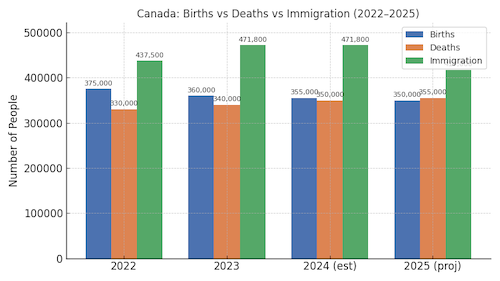
Despite this, some political leaders advocate for significant cuts to immigration. Such actions would push Canada into demographic retreat, leading to economic self-sabotage. Newcomers contribute skills, spend money, pay taxes, and fill critical gaps in an aging workforce. Immigration is an investment, not an expense. Reducing it without an unforeseeable increase in fertility will lead to a shrinking workforce, rising dependency ratios, and long-term stress on our economy and social programs.
Immigrants are essential for various sectors: they provide the plumbers and electricians needed for housing construction, the personal support workers and nurses who care for our aging population, the researchers and scientists who drive innovation, and the international students whose tuition supports our universities. Without these contributors, Canada loses economic momentum, capacity, and future possibilities.
Understanding Immigration Streams
The public discourse often oversimplifies immigration, lumping all categories together. In reality, immigration encompasses multiple streams: permanent residents, refugees, temporary foreign workers, and international students, among others. Each category contributes uniquely to the country’s welfare. While the initial settlement patterns of immigrants are often concentrated in major urban centres, internal migration trends suggest a more nuanced picture.
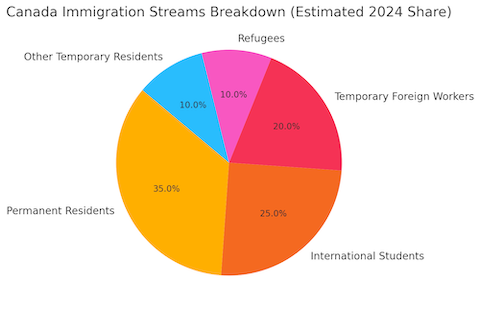
Breakdown of estimated 2024 immigration streams by category
Addressing Capacity Challenges
Concerns about Canada’s capacity to absorb rapid population growth are valid. While these issues are often attributed solely to immigration, a deeper analysis reveals long-standing systemic problems with infrastructure and planning.
The Myth of Infrastructure Overload and the Urban Bottleneck
Historically, new immigrants predominantly settle in Canada’s largest urban centres, drawn by established communities, diverse job markets, and support services. However, a contrasting trend reveals that while these cities attract many newcomers, their long-term immigrant retention rates are declining. Immigrants are increasingly moving to smaller urban centres or other provinces, often in search of more affordable housing and better job prospects.
This paradox highlights the urgent need for a more balanced approach to immigrant settlement. “Regionalization” strategies, aimed at encouraging immigrant dispersion to smaller and medium-sized cities, are crucial. For these efforts to succeed, substantial investment in infrastructure and support services in these “second-tier cities” is required. Canada’s major cities have largely grown beyond their capacity to effectively serve the bulk of population growth, and the failure to facilitate growth beyond these centres is a critical issue that predates and will persist with or without immigration. Without immigration, however, we lack the financial and human resources to execute needed infrastructure projects.
Housing Policy: A Failure to Align
Experts largely attribute the housing crisis to decades of under-building, rather than solely to newcomers. The Canada Mortgage and Housing Corporation (CMHC) estimates that housing starts need to nearly double to 430,000-480,000 units per year until 2035 to meet demand and restore affordability.
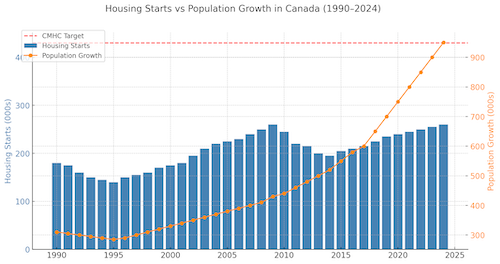
Bar chart of housing starts alongside a line chart of population growth (in thousands), with a CMHC target reference line.
A critical issue is the “policy mismatch” where immigration targets, particularly for temporary residents, have not been adequately aligned with housing supply planning. This has placed unsustainable pressure on an already constrained housing market. Canada is currently in a “population trap,” where growth outpaces the ability to build homes and essential infrastructure. In 2023, for every new home started, there were 5.1 new residents, a significant imbalance. The government’s recent reduction in immigration levels is a reactive step, indicating a lack of integrated planning. This situation risks harming the long-term benefits of immigration and Canada’s appeal to skilled workers. A coordinated, long-term plan directly linking immigration goals with clear targets for housing and infrastructure is urgently needed.
Strain on Subsidized Housing, Healthcare, and Social Services
Many Canadians are feeling the squeeze on public services, including housing (73% concerned), healthcare (62% concerned), and social services (59% concerned). Homeless shelters are struggling to accommodate recent immigrants and asylum seekers.
While newcomers often arrive in good health—the “healthy immigrant effect”—their health needs tend to converge with the general population within five to ten years, increasing their use of healthcare services. This underscores the need for proactive planning and investment in our healthcare system to ensure it can keep pace with the needs of a growing population, both long-time residents and new arrivals. It’s crucial to remember that these investments are necessary even with natural population growth.
Economic Implications of Immigration
Canada’s economic picture is mixed. While overall GDP continues to grow, per-capita GDP has been shrinking, which is unusual outside of a recession. This suggests that the economic “pie” isn’t growing fast enough for everyone to get a bigger slice, perhaps due to insufficient investment in the tools and infrastructure needed to support growth.
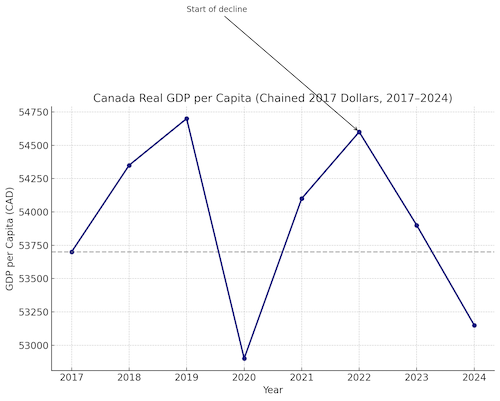
A line chart showing Canada’s real GDP per capita (chained 2017 dollars), highlighting the recent decline in 2023 and 2024.
The GDP Factor and Labor Market Effects
While recent government changes to slow population growth might slightly affect the overall economy, they are not expected to drastically alter the per-person wealth trend. For immigration to truly benefit everyone, Canada needs to focus on enabling newcomers to fully contribute and investing in the necessary infrastructure and opportunities for prosperity. Continued rapid growth without proper support could lead to increased public concerns about living standards.
The labor market presents a complex situation. While the unemployment rate has risen and job searches are longer, Canada still faces significant shortages of skilled professionals in sectors like healthcare, construction, and trucking, where immigrants already make up a substantial portion of the workforce. This indicates a mismatch between available jobs and the skills of new arrivals, often due to difficulties in credential recognition. Better planning is needed to ensure immigrant skills are fully utilized.
Economic Implications of Zero or Negative Growth
Slowing or shrinking Canada’s population would accelerate the aging of our country. Younger newcomers have been crucial in maintaining a vibrant workforce as Baby Boomers retire. An aging population means fewer working-age people contributing taxes and more retirees needing support from healthcare and pensions, creating significant fiscal challenges.
While slower growth might offer a temporary reprieve for housing, it won’t solve the underlying affordability issues. In fact, cutting immigration too much could worsen shortages of construction workers, hindering home building. Fewer people overall also means less productive capacity and a smaller consumer base, leading to slower economic growth. Experts suggest our economy could grow 0.5% less than expected by the end of 2025 with slower population growth. Historically, Canada has relied on immigration to maintain economic strength and youthfulness. A shift towards very slow or no population growth would reverse this “demographic dividend,” leading to a faster aging population, increased strain on social programs, and less overall economic activity. Policymakers face a significant balancing act: addressing immediate pressures versus ensuring long-term economic health. Reducing immigration levels necessitates a focus on boosting the productivity of the existing workforce, fostering innovation, and increasing domestic labor force participation.
The Different Types of Immigration and Future Directions
Understanding the specific contributions and challenges of different immigration categories is essential for informed policy.
International Students: A Significant Economic Driver
International students are a major economic force, contributing over $30 billion to Canada’s GDP in 2022 and supporting hundreds of thousands of jobs. Universities heavily rely on their tuition fees. However, the rapid increase in student numbers has strained communities, particularly housing. While recent caps on student visas aim to ease this pressure, they financially impact universities and risk cutting off a vital pipeline for future skilled workers, as many international students become permanent residents.
Work Visas: Filling Gaps, Facing Scrutiny
Temporary Foreign Worker Programs (TFWP) and other work permit programs play a crucial role in filling labor gaps in sectors like agriculture, construction, and healthcare. However, concerns about potential wage suppression or impact on Canadian job seekers have been raised. The government plans to reduce the overall number of temporary residents to no more than 5% of the total population by late 2026. While this may offer short-term relief for housing and unemployment, it could lead to an older population and fewer workers, potentially affecting GDP growth and increasing strain on government services as more Baby Boomers retire.
Attracting the Brightest Minds: Beyond Temporary Visas
Canada remains committed to attracting global talent through permanent residency pathways like the Global Talent Stream and Express Entry for STEM fields. However, if Canada becomes less attractive as a place to study and then immigrate, it could impact our long-term supply of skilled workers. The success of these targeted programs is crucial for attracting top talent.
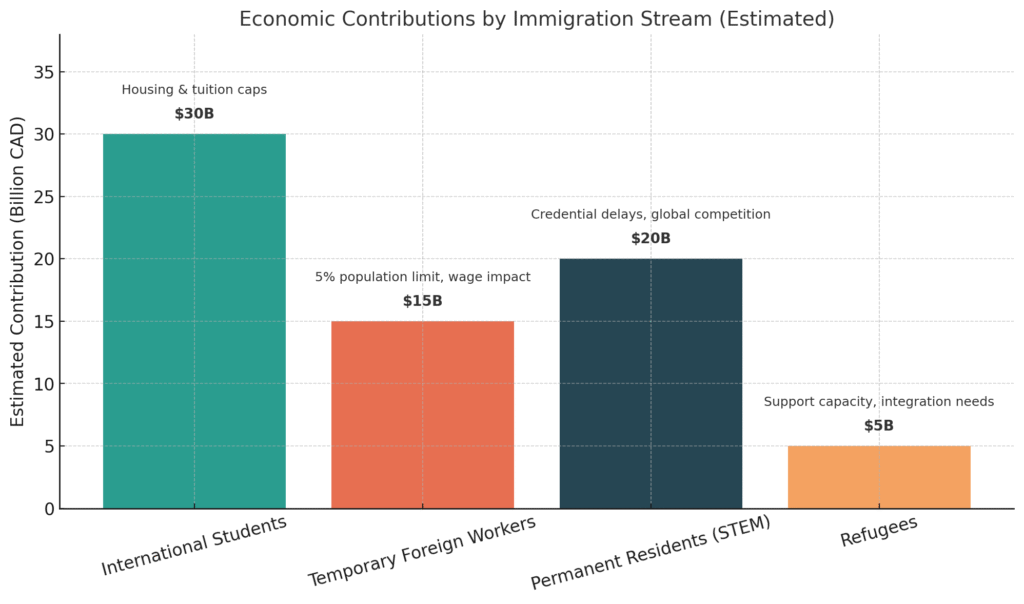
Estimated economic contributions by immigration stream (2022–2024), showing the relative impact of international students, temporary foreign workers, permanent residents in high-demand sectors, and refugees. Each category faces distinct policy challenges that affect Canada’s ability to plan for and benefit from immigration effectively.
Addressing Common Concerns About Immigration
It’s important to address common concerns raised by those advocating for reduced immigration:
- Canada’s Capacity: It’s true that rapid population growth has strained housing, healthcare, and services. The government’s recent actions acknowledge these issues. However, sustained “negative population growth” carries significant long-term risks, including accelerated population aging and increased pressure on social programs. It’s a complex trade-off.
- “Broken” Programs: There have been legitimate concerns about the operation and integrity of some international student and temporary worker programs. The government has acknowledged the need for more sustainable and well-managed temporary resident programs, supporting the view that “broken” aspects have existed.
- Orderly and Skilled Immigration: There is broad agreement on the need for a more orderly immigration process that efficiently clears backlogs and better integrates skilled professionals. Despite rising unemployment, shortages persist in many skilled fields, emphasizing the importance of aligning immigrant skills with economic needs and recognizing foreign credentials.
What’s Next for Canada’s Growth?
Canada is at a critical juncture. Our population growth is now almost entirely dependent on international migration, and the recent rapid increase has placed immense pressure on housing, services, and infrastructure. While overall GDP has grown, per-capita GDP has declined, indicating that economic growth isn’t keeping pace with population growth for individual Canadians. This situation, with rising unemployment alongside skilled labor shortages, highlights a clear mismatch in our job market.
The government’s recent policy changes are a reaction to these pressures. However, a sustained shift to very slow or negative population growth would likely reverse Canada’s “demographic bonus” from younger immigrants, leading to an older population and increased strain on social programs.
Moving forward, Canada needs a smarter, more strategic approach:
- Integrated Planning: Directly linking immigration targets with realistic goals for housing, infrastructure, and service development. This requires proactive, integrated national planning, moving beyond reactive crisis management.
- Targeted Immigration: Focusing on matching immigrant skills to specific economic needs and simplifying credential recognition for internationally trained professionals.
- Smarter Temporary Programs: Ensuring temporary worker programs genuinely address short-term labor gaps without negatively impacting wages or discouraging domestic training.
- Supporting Regional Growth: Investing significantly in infrastructure and support services in smaller and medium-sized cities to make them genuinely attractive and sustainable destinations for newcomers, thereby alleviating pressure on major urban centres.
By addressing these critical areas, Canada can ensure that immigration remains a powerful force for the nation’s long-term prosperity and well-being.
Conclusion
Canada has arrived at a pivotal moment in its demographic and immigration policy. Our population growth is now almost entirely reliant on international migration, making our future population trajectory exceptionally sensitive to global patterns and our own evolving policies.
The rapid acceleration of population growth, particularly driven by an unprecedented surge in non-permanent residents post-2019, has strained Canada’s absorptive capacities. The housing crisis, characterized by a severe supply-demand imbalance and a widening gap between new residents and housing starts, is a stark manifestation of this, indicating that Canada has entered a “population trap.” This capacity strain extends to social services, healthcare, and public infrastructure, leading to widespread public concern and a perceived “scarcity mindset.”
Economically, while overall GDP has grown, Canada has experienced a concerning and sustained decline in per-capita GDP, suggesting that rapid population growth has not been matched by sufficient capital investment, productivity gains, or effective integration of new labor into high-value-added sectors. The labor market exhibits a dual reality: rising overall unemployment alongside persistent skilled labor shortages, pointing to a mismatch between labor supplied through immigration and specific economic demands.
The government’s recent policy adjustments to curb temporary and permanent resident intake are a reactive response to these strains. However, a sustained policy of zero or negative population growth would likely reverse Canada’s demographic dividend, accelerating population aging, reducing labor force participation, and intensifying fiscal pressures on social programs, thereby undermining long-term economic growth potential.
In conclusion, Canada faces a complex challenge: leveraging immigration for demographic and economic vitality while ensuring that growth is sustainable and benefits all residents. The current situation highlights a significant lag in integrated planning between immigration policy and the development of essential infrastructure and social services. Moving forward, a more strategic and nuanced approach is imperative:
- Integrated Planning: A cohesive, multi-ministerial strategy is needed to directly link immigration targets with measurable goals for housing construction, infrastructure development, and social service expansion. This requires a shift from reactive crisis management to proactive, integrated national planning.
- Targeted Immigration and Skill Utilization: Immigration policy must prioritize not just quantity but also the quality of economic integration, aligning immigrant skills with verified labor market needs and addressing barriers to credential recognition.
- Sustainable Temporary Programs: A critical re-evaluation of temporary resident programs is necessary to ensure they genuinely address short-term labor gaps without suppressing wages, displacing Canadian workers, or disincentivizing domestic training and technological investment.
- Regionalization with Support: Efforts to encourage immigrant settlement in smaller and medium-sized cities must be accompanied by substantial investment in infrastructure and support services to make these regions genuinely attractive and sustainable destinations.
By addressing these critical areas, Canada can strive to ensure that immigration continues to be a net positive force for the nation’s long-term prosperity and societal well-being. We must collectively work towards this in the coming decades, relying on facts and avoiding making immigration a recurring wedge issue.
Want a copy for your personal use? Download the Free Printable PDF
About the Author
Leni Spooner is a Canadian writer, researcher, and civic storyteller. She is the founder of Between the Lines | Kitchen Table Politics, a longform publication exploring how policy, economics, food systems, and everyday life intersect. Her work blends historical context with present-day analysis, helping readers see the deeper patterns that shape Canada’s choices — and the lives built around them.
If you enjoy thoughtful, independent writing, you can:
👉 Subscribe to Between the Lines to receive updates and new essays
👉 Buy Leni a coffee to support this work
© 2025 Between the Lines
Independent political and public life commentary from Canada
Follow on X and Bluesky. as well as on Substack · Medium
Site by Leni Spooner · Built on WordPress & Cornerstone
Privacy & Commitment · Contact