
Living next door to a superpower has always shaped Canada’s choices. What’s changed is the reliability of the system we built that relationship on.
Living Next Door to a Superpower in a G-Zero World
By Leni Spooner, creator of Between the Lines.
The neighbour we built our house beside
For most of Canada’s modern history, living next door to the United States has felt like sharing a fence with a very large, occasionally noisy neighbour — but one who generally followed the same rules of the road.
Even when Washington made decisions we disagreed with, there was comfort in the predictability. Institutions mattered. Agreements endured. Someone, somewhere in the system, still had a hand on the wheel.
That assumption no longer holds.
According to the annual Top Risks 2026 outlook produced by Eurasia Group, the United States has become the principal source of global risk — not because of an external enemy, but because of an unresolved political revolution unfolding inside its own institutions.
Canada is not facing a hostile United States. It is facing an unsettled one — and that difference matters.
When the anchor drifts, the boats tied to it don’t stay still.
A political system under renovation, not repair
Eurasia Group is unusually precise in how it describes the current American moment. This is not framed as polarization, democratic backsliding, or executive overreach.
It is described as a system-level political revolution.
What began as tactical norm-breaking has evolved into something deeper: a sustained effort to weaken the constraints on presidential power itself — courts, Congress, inspectors general, independent agencies, civil service protections, and the informal but powerful norms that once restrained executive action.
Crucially, this transformation is not temporary or personality-driven. Regardless of how Donald Trump’s second term ultimately ends, there is no return to the pre‑Trump status quo. The precedents set, powers tested, and guardrails weakened will remain in place for whoever follows.
For decades, Canada built its economy and security on American predictability — not American goodwill. Predictability is what’s eroding now.
And when predictability erodes, coordination gets harder long before conflict becomes visible.
Who Eurasia Group is — and why their analysis matters
Before going further, it’s worth pausing on the source.
Eurasia Group is one of the world’s leading political risk consultancies, founded by political scientist Ian Bremmer. Governments, multinational companies, financial institutions, and international organizations rely on its analysis to understand how political systems shape markets, security, and global stability.
Its annual Top Risks report is not advocacy or punditry. It is a forward‑looking assessment of where political institutions are likely to strain, fracture, or misfire — based on observed behaviour, institutional capacity, and incentives rather than campaign rhetoric or cable‑news cycles.
In other words, this is analysis designed for people who need to make decisions before the crisis becomes obvious.
When erosion becomes normal
One of the most revealing elements of the Top Risks 2026 report is the Governance Tracker — a chart that plots major Trump administration actions along two dimensions:
- Erosion of institutional checks (how much an action weakens constraints on presidential power)
- Erosion of norms (how far it departs from established practice and precedent)
Actions that score high on both are classified as “revolutionary.”
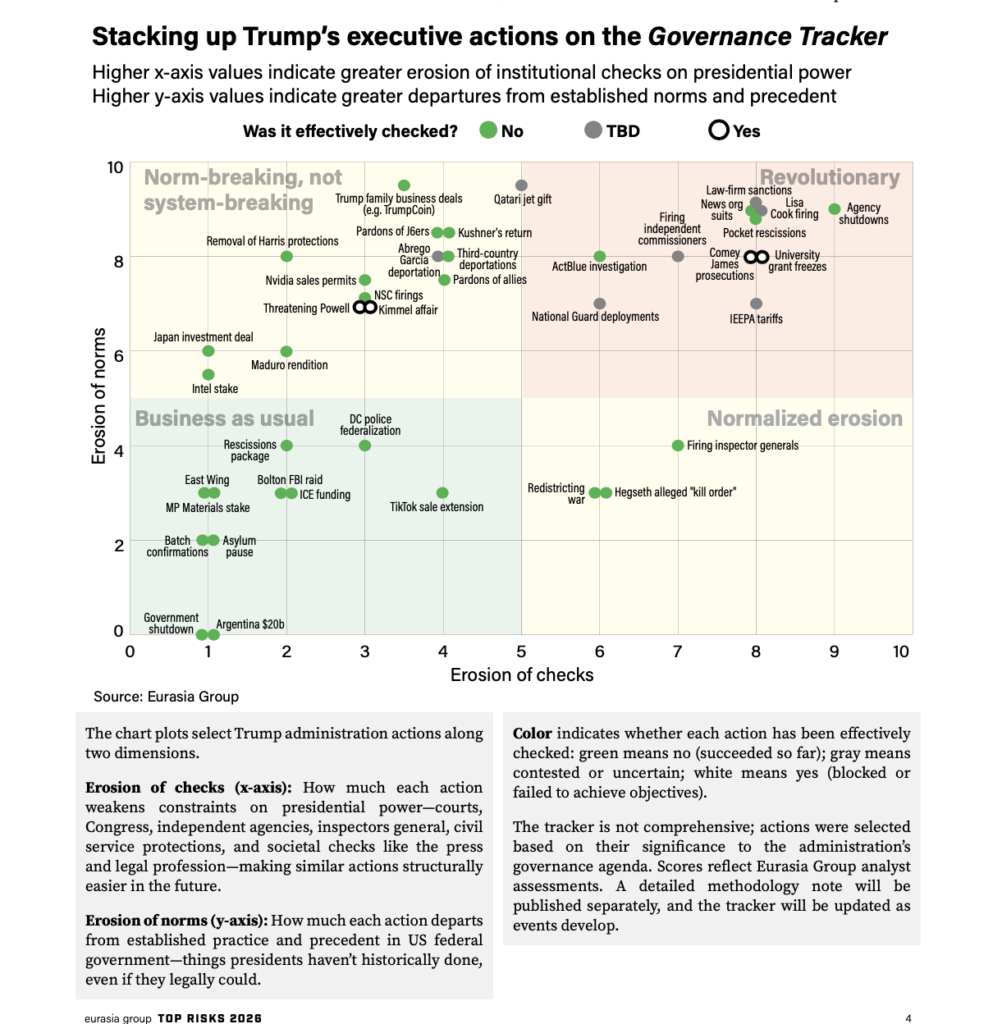
What stands out one year into the administration is not simply how many actions land in this revolutionary quadrant — but how many have not been effectively checked.
Congress largely went along. Courts intervened slowly, often after the damage was already done. Media companies, law firms, universities, and corporations increasingly chose settlement, silence, or compliance over confrontation.
Institutions rarely collapse with a crash. They erode with a shrug — one precedent at a time.
Even when actions face legal challenges, they frequently achieve their strategic purpose anyway: chilling behaviour, shifting precedent, and normalizing what once would have been unthinkable.
What matters is not whether an action is eventually challenged, but whether it succeeds long enough to change behaviour.
Once that line is crossed, predictability becomes a memory rather than a feature.
The world without a centre: what “G‑Zero” actually means
This internal American upheaval would be destabilizing on its own. But it’s unfolding inside a broader global condition often described as a G‑Zero world.
A G‑Zero world is not one where power disappears. It is one where no country — or group of countries — reliably provides leadership, sets enforceable rules, or stabilizes crises when things go wrong.
A G‑Zero world isn’t one without power. It’s one without a reliable referee.
For decades, even critics of U.S. dominance could count on Washington to play an anchoring role — underwriting trade systems, coordinating allies, responding to shocks, and keeping disputes from spiralling.
That era is ending, not because another power has replaced the United States, but because the United States itself is stepping away from that function.
Europe, meanwhile, faces paralysis at best and destabilization at worst. France, Germany, and the United Kingdom are each grappling with weak governments, fractured politics, and limited capacity to lead beyond their borders.
The danger of a G‑Zero world isn’t chaos — it’s drift, misalignment, and slow coordination failure.
And drift is hard to respond to because it rarely announces itself.
Where Canada actually sits
In this emerging landscape, Canada is best described as a country that must defend itself, hedge its bets, and muddle through rather than reshape the global order.
That description is neither flattering nor insulting. It’s realistic.
Canada isn’t positioned to reshape the global order. We’re positioned to absorb its instability.
That reality shows up first in trade.
Trade agreements may still exist on paper, but enforcement becomes selective, politicized, and contingent on presidential preference rather than institutional process.
For a trade‑dependent country like Canada, predictability matters more than friendliness — and predictability is what institutional erosion destroys first.
It also shows up in security.
Canada’s consistent support for Ukraine places it squarely within NATO’s exposed flank — even if geography tempts us to feel insulated.
What hybrid risk looks like for Canada
As the war in Ukraine grinds on, Russia is increasingly shifting its focus toward hybrid warfare against NATO: cyber operations, infrastructure sabotage, disinformation campaigns, and harassment of allied forces — actions deliberately calibrated to remain below the threshold of open war.
Hybrid risk rarely looks like tanks crossing borders. It looks like friction.
It looks like:
- cyber incidents that disrupt logistics, communications, or data systems
- disinformation campaigns that target public trust or alliance cohesion
- harassment of Canadian deployments abroad
- pressure on infrastructure, contractors, or institutions that sit just outside the spotlight
Each incident is manageable on its own. The risk lies in accumulation — not escalation.
Hybrid risk doesn’t try to break you. It tries to tire you.
And fatigue is often more politically effective than force.
A quick guide to the risks Canadians should be watching in 2026
Before closing, it’s worth pausing to name — plainly — the major risk factors that flow from this moment. Not all of them require deep explanation here. But together, they form a practical checklist Canadians can keep in mind as the year unfolds.
This is not a prediction list. It’s a situational awareness list — the pressures most likely to shape Canada’s economy, security, and room to maneuver in 2026.
1. The U.S. political revolution
The central driver. An unusually personalized and volatile U.S. political system makes Canada–U.S. relations less institutional and more contingent, increasing trade, diplomatic, and economic uncertainty.
2. Zombie USMCA (CUSMA)
The trade agreement survives, but in a weakened, unstable form. Sectoral tariffs on autos, steel, aluminum, lumber, and energy remain a standing risk — used as leverage rather than policy.
3. State capitalism, American-style
Access to the U.S. market increasingly depends on political alignment, concessions, or investment-for-relief deals. Canadian firms operating by the rules face pressure to compete in a pay-to-play environment.
4. The Donroe Doctrine in the Western Hemisphere
A more assertive U.S. posture in the Americas keeps Canada on the defensive — on sovereignty, Arctic security, defence spending, and energy exports — while limiting Ottawa’s room to disagree openly.
5. Europe under strain
Weak and inward-focused governments in the U.K., France, and Germany limit Canada’s ability to diversify trade, defence, and diplomatic partnerships away from the United States.
6. Russia’s hybrid pressure
Canada’s support for Ukraine and NATO deployments increase exposure to cyber operations, disinformation, and other grey-zone activity — especially against military, infrastructure, and public trust targets.
7. China’s deflation trap
Weak Chinese demand and industrial overcapacity complicate Canada’s trade diversification. Lower-cost Chinese exports create domestic pressure, while tariffs and geopolitics constrain Ottawa’s options.
8. The global energy and industrial split
China’s dominance in clean energy technologies collides with the U.S. push for fossil fuel exports. Canada is attempting to straddle both paths, with uncertain economic and political results.
9. AI pressure and opportunity
U.S. tech firms are moving toward extractive AI business models, while Washington resists foreign regulation. Canada faces retaliation risks — but also a genuine opportunity to build smaller, purpose-driven AI capacity.
10. The G-Zero backdrop
All of the above unfold in a world with no reliable referee. Coordination failures, slower crisis response, and policy drift become the norm rather than the exception.
Living beside a moving fault line
None of this requires panic. But it does require clarity.
Canada is not facing a hostile United States. It is facing an unsettled one.
In a G‑Zero world — where anchors drift, institutions weaken unevenly, and leadership is fragmented — the countries that fare best are not the loudest or the strongest. They are the ones that notice early, adjust quietly, and stop mistaking familiarity for safety.
Familiarity is not the same as safety — especially when the ground is still shifting.
At the kitchen table, this isn’t about choosing sides or predicting collapse. It’s about recognizing that the ground under our neighbour’s house is moving — and making sure our own footing is steady enough to ride out the tremors.
Quietly. Deliberately. Together.
Further Reading & Sources
Eurasia Group’s Top Risks of 2026
Top Risks is Eurasia Group’s annual forecast of the political risks that are most likely to play out over the course of the year. This year’s report was published on 5 January 2026.
Read implications for Canada:
Eurasia Group’s Top Risks of 2026 for Canada
You might also be interested in reading
About the Author
Leni Spooner is a Canadian writer, researcher, and civic storyteller. She is the founder of Between the Lines | Kitchen Table Politics, a longform publication exploring how policy, economics, food systems, and everyday life intersect. Her work blends historical context with present-day analysis, helping readers see the deeper patterns that shape Canada’s choices — and the lives built around them.
If you enjoy thoughtful, independent writing, you can:
👉 Subscribe to Between the Lines to receive updates and new essays
👉 Buy Leni a coffee to support this work
Comments 1
Pingback: Canada’s Fighter Jet Choice Is No Longer Just About Jets - Between the Lines | Canadian Politics, Food Systems & Sovereignty