
How development charges quietly fund Canada’s growth — and what happens when the web is pulled too tight.
By Leni Spooner | Between the Lines Canada
The Invisible Invoice
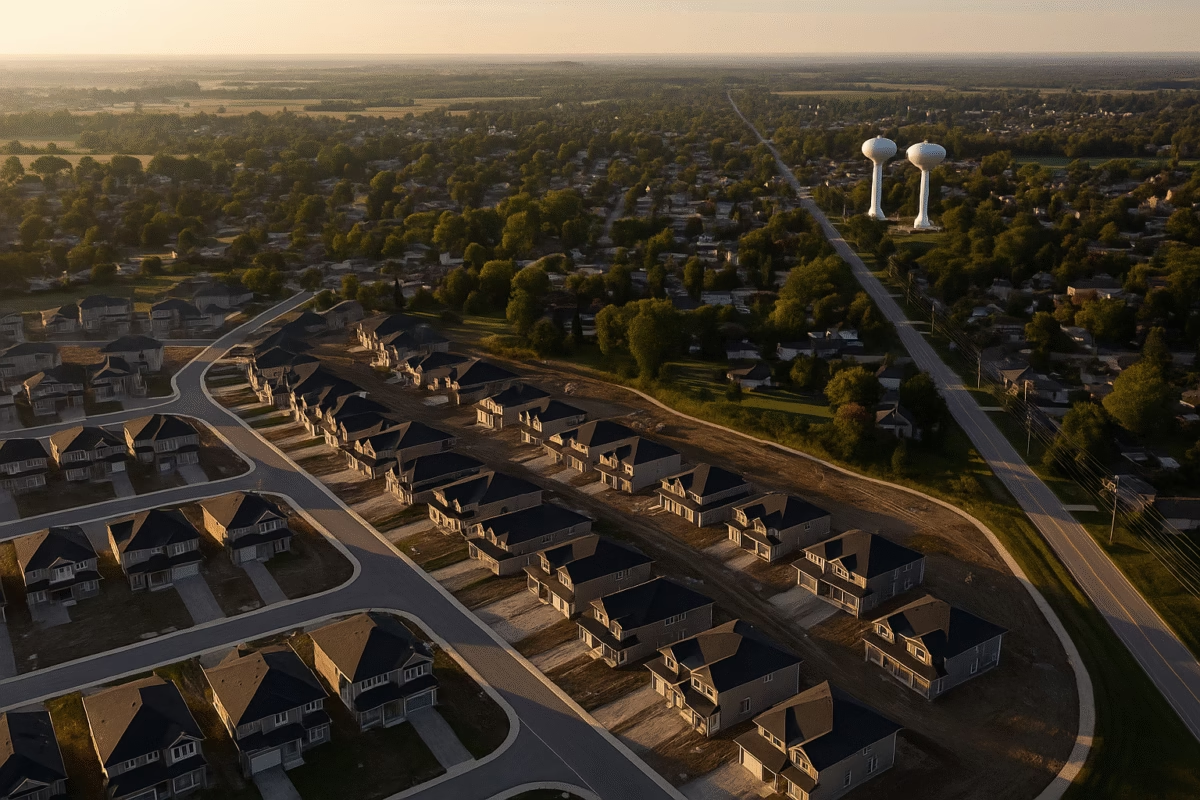
Picture a new subdivision breaking ground on the edge of town—fresh pavement, tidy curbs, marketing banners promising modern lakeside living.
Most of us assume the developer covers the costs and the town collects a tidy fee before handing over building permits. But what happens to that money once the backhoes move in? Who pays for the deeper things—the water mains, storm sewers, fire-hall upgrades, and the new bus route that will one day serve the families moving in?
Every new home tugs at a thread in a much larger web of public infrastructure. When one strand—say, a development-charge freeze or a fee hike—is pulled, the whole web quivers. Municipal budgets stretch, provincial rules adjust, federal grants appear or disappear, and everyone from homebuyers to taxpayers feels the vibration in some way.
Understanding that web is the only way to understand Canada’s housing debate. Behind every home price is a plumbing of costs and responsibilities that connect three levels of government and thousands of kilometres of pipe.
The Idea That Growth Should Pay for Growth
Development Charges (“DCs”)—the one-time fees builders pay when new homes or commercial projects are approved—exist so that growth pays for growth.
Those dollars are legally ring-fenced: every municipality must keep them in dedicated reserve funds that can be spent only on approved “growth-related” capital—things like water and wastewater pipes, storm drainage, roads, fire trucks, parks, libraries, and transit vehicles.
Across Canada, the principle is the same even if the numbers vary.
In big cities, a single detached home can carry over $100 000 in development charges; in smaller towns the fee might be $15 000–$30 000. But those numbers don’t vanish into bureaucracy—they sit in municipal reserve accounts until the corresponding infrastructure project moves ahead.
In Ontario, the rules are set by the Development Charges Act, which requires municipalities to
- prepare a background study quantifying growth and infrastructure needs,
- hold public hearings before setting rates, and
- keep and publish annual reserve-fund statements.
So while the line on a building permit looks simple, the accounting behind it isn’t.
Where the Money Goes
Think of a new subdivision as a starter-kit for a miniature city.
Before anyone moves in, the town must size water pipes, widen roads, extend streetlights, and expand fire-response coverage. Those upfront costs can run into tens of millions, and development-charge revenue is what allows towns to borrow or budget responsibly to cover them.
A typical breakdown in mid-sized Ontario municipalities looks roughly like this:
- Water & Wastewater – 35 %
- Roads – 25 %
- Parks & Recreation – 15 %
- Fire & Emergency – 10 %
- Library, Transit & Other – 15 %
Each of those buckets is tracked separately. Money collected for parks can’t pave a road, and road dollars can’t fund a fire hall. This separation keeps development fees from being treated as general-revenue cash grabs.
In larger centres such as Mississauga or Vaughan, DCs may fund hundreds of capital projects each year. Smaller towns like Wasaga Beach, Ontario see fewer, but the principle is the same.
The Layers of Responsibility
Municipalities collect DCs and deliver the infrastructure but can’t levy income or sales taxes. Their fiscal toolbox is limited to property taxes, user fees, and these one-time charges.
Provinces set the rules—deciding what services are eligible, how rates are calculated, and how long municipalities must phase them in. Ontario’s Bill 23 (2022) and subsequent housing legislation required phased-in fee reductions, effectively lowering municipal revenue.
Ottawa has entered the game with the Canada Housing Infrastructure Fund (CHIF) and Housing Accelerator Fund (HAF), which tie federal infrastructure grants to commitments like fee moderation or streamlined approvals.
So when a province caps fees to spur housing, or Ottawa offers funding only if towns freeze them, the web shifts.
Municipalities still have to build the pipes but now rely on uncertain senior-government transfers to fill the gap.
A 2023 Federation of Canadian Municipalities study estimates that for every $1 in new-housing investment, $0.87 of resulting tax revenue flows to senior governments and only $0.13 stays local.
That imbalance explains why even booming communities can feel broke.
Fee Freezes and the Myth of Affordability
Developers often argue that high fees inflate home prices. It’s partly true—but only partly. Economic studies show that less than half of a fee change typically passes through to the buyer; the rest is absorbed through land costs or profit margins. In hot markets, prices are set by demand, not fee structure.
Freezes aren’t automatically reckless either. When higher levels of government step in with matching infrastructure grants, a temporary freeze can make sense. The danger arises when freezes happen without replacement funding—because infrastructure still has to be paid for, just later, through higher property taxes or deferred maintenance.
So the real question isn’t whether to charge, but who ultimately pays when we don’t.
A Local Lens: Wasaga’s Balancing Act
Wasaga Beach, Ontario illustrates the dilemma faced by many small towns.
Its growth is seasonal and its economy tourism-heavy. The town must maintain big-city infrastructure—water, wastewater, shoreline protection—on a small-town tax base.
Development-charge revenue helps bridge that gap, funding water-system expansion, road improvements, and recreation amenities that serve both residents and visitors. Yet the town’s public documents don’t spell out exactly how much sits in reserve or which future projects depend on those funds. That opacity is common among smaller municipalities that lack the staff to produce dashboards like Toronto’s or Mississauga’s.
It isn’t corruption; it’s capacity. But it matters—because citizens can’t have an informed debate about fee freezes or affordability if they can’t see the numbers.
A System Too Complex for Slogans
Canada’s housing conversation often drifts toward slogans—“cut red tape,” “build faster,” “scrap the fees.” But development charges aren’t a speed bump; they’re part of the suspension. Remove them without strengthening other supports and the whole vehicle rattles apart.
The truth is messy but manageable:
- Growth can be made more affordable if senior governments share their tax windfalls.
- Fee reductions can help if they’re replaced by predictable infrastructure transfers.
- Transparency can rebuild trust if municipalities show where the money goes.
Each of those “ifs” connects to another strand in the web.
Where We Go Next
Our municipalities build the bones of growth, but our fiscal system leaves them under-fed.
Understanding development charges isn’t about defending fees or attacking builders; it’s about seeing the spider web for what it is—a delicate network that only works when every strand holds.
When that web trembles, the question shifts from how growth is funded to how long a town can hold the weight.
The First Strand to Tremble
When politicians promise to “cut red tape” or “pause developer fees,” it sounds harmless—even hopeful. If development charges (DCs) help pay for infrastructure, the logic goes, wouldn’t reducing them help build homes faster?
Sometimes it does—but rarely without consequence. A single thread in the fiscal web can’t be loosened without the others shifting. Municipalities don’t print money; they move it between buckets. And when one bucket shrinks, another—property taxes, user fees, or debt—quietly fills the gap.
How a Freeze Actually Works
A development-charge (DC) freeze doesn’t mean the work stops. Pipes still need to be laid, water plants expanded, parks graded, and fire engines replaced. It simply means someone else must front the cost.
Unfunded Freeze
– Fees capped or phased-out with no replacement revenue
– Gap filled by borrowing or higher property taxes
– York Region projected a 5–8 % tax increase after Bill 23
Subsidized Freeze
– Lost revenue replaced by senior-government grants (CHIF, HAF)
– Gap covered federally or provincially
– Toronto’s 2025 CHIF agreement kept projects on schedule
Targeted Freeze
– Temporary or narrow waiver (rental, non-profit)
– Cost absorbed elsewhere in budget
– Guelph’s pilot for non-market housing met its goal without broad shortfalls
Each approach sends different tremors through the web: the first weakens the municipal strand, the second relies on federal tension to hold the net, and the third bends carefully, like a spider testing a gust of wind.
A Small-Town Example on the Edge of the Bay
Wasaga Beach, Ontario is one of those towns where every strand matters. Its economy swings with the seasons—busy in July, quiet in February—yet its infrastructure must serve both.
The town’s 2021 Development Charges By-law lists the same growth ingredients as larger cities: roads, water and wastewater systems, fire services, parks, and recreation.
During the height of Ontario’s Bill 23 debate, Wasaga Beach council faced the familiar pressure: freeze fees to help builders, or keep rates steady to protect infrastructure. Officials warned that reductions would strain already-tight reserves earmarked for water-system upgrades and shoreline work.
So far, the town has taken a middle path—maintaining rates while seeking federal support through the Canada Housing Infrastructure Fund. That balancing act shows how fragile the municipal strand is: a single policy shift can ripple through a budget built on seasonal tourism and steady retirees.
The Economics of Intention
Cutting fees doesn’t automatically cut home prices. Research from C.D. Howe and IMFG shows that only 40–60 % of a DC change reaches buyers; the rest is absorbed through land prices or margins. When fees drop, municipalities lose infrastructure revenue while builders often capture most of the savings. And when infrastructure lags, those same builders face delays hooking into water or road systems—a quiet loop of unintended cost.
What Happens Down the Line
The danger of fee freezes isn’t a budget blow-up; it’s the slow erosion of resilience.
Deferred Maintenance — Projects slip a year or two and inflation quietly adds millions.
Debt Creep — Towns borrow more, binding future taxpayers to higher repayments.
Hidden Cross-Subsidy — Existing residents end up funding growth through property taxes.
Public Trust Erosion — Citizens see new housing but no new parks and assume funds were misused.
A spider web can stretch astonishingly far, but pull too hard on one side and something gives.
A Better Way to Share the Load
Fee reform doesn’t have to mean revenue loss. If senior governments shared even a fraction of their tax windfall from new construction—a slice of GST or land-transfer tax—towns could lower fees without stalling infrastructure.
The Federation of Canadian Municipalities estimates that only 13 ¢ of every growth-related tax dollar stays local. Even a modest rebalancing would let municipalities cut DCs and still keep the pipes flowing.
Fee freezes alone don’t solve affordability. Revenue sharing does.
What Citizens Deserve to See
Small towns shouldn’t fly blind. Every municipality could publish a simple dashboard showing how development-charge (DC) dollars are collected, spent, and carried forward.
Mississauga already does this—and misinformation about “hidden fees” has plummeted. Transparency is a low-cost strand that strengthens the whole web.
The Lesson of the Web
A freeze isn’t always a failure; sometimes it’s a sign that the system is trying to rebalance. But in a country where municipalities shoulder most infrastructure responsibility with the fewest tax tools, pulling too hard on the local strand risks tearing the whole web.
Canada’s housing challenge isn’t about greedy builders or reckless towns; it’s about a fiscal ecosystem that hasn’t kept up with how we actually live. Wasaga Beach, Ontario—like hundreds of small communities across the country—is doing its best to hold the net steady, building the bones of growth while waiting for the upper threads to share the weight.
Kitchen-Table Reflection
Every time a town waives a fee to speed up a build, it quietly writes an IOU to the future. That IOU might fund a water plant, a bridge, or a shoreline defence that today’s taxpayers will never see but their children will need. Fee freezes may look like affordability today, but they’re often just a bill we’ve pinned to the fridge for tomorrow.
To keep more of these conversations going, share or subscribe to Between the Lines Canada—and help build a country where growth truly pays for growth, and every strand holds.
Support the project at buymeacoffee.com/lenispot.
Join in here: Subscribe to Between the Lines.
About the Author
Leni Spooner is a Canadian writer, researcher, and civic storyteller. She is the founder of Between the Lines | Kitchen Table Politics, a longform publication exploring how policy, economics, food systems, and everyday life intersect. Her work blends historical context with present-day analysis, helping readers see the deeper patterns that shape Canada’s choices — and the lives built around them.
If you enjoy thoughtful, independent writing, you can:
👉 Subscribe to Between the Lines to receive updates and new essays
👉 Buy Leni a coffee to support this work